
Mining for Black California Gold
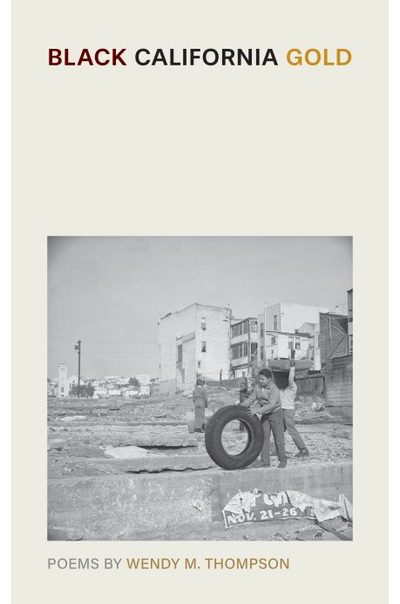
Black California Gold
Wendy Thompson
Bucknell University Press. 2025
A map holds a version of a place that never dies. It is fixed in that moment of archival freeze: the exact date, the exact time, the point of discovery. A birth. Of a nation. A death. Of a destiny, manifested through all of those names etched into water, state, forest, county, mountain, highway. A map made by men. Borders. There is no marking outside of the directional flow of a concrete creek bed and its southwestern bend — its angle inexact but recorded as exact on a map. In kilometers. Metric feet. There is a topographical assumption that on every map of a city, the hills harbor all the rich white people who look down at the rest of us. Wherever there are swathes of yellowish-brown indicating altitude, dimension, and sea level, there is the topographic assumption that that is where we live and die — in the flatlands, a point that will eventually be flooded while the rich white people watch from their hills with a glass of wine in hand, remarking, What is all that calamity taking place down there? (Pointing.)
)
The map will change with each reprinting. A new map will be issued. Even now, I am dating myself because what is a reprint when everything is done digitally? What is a dried creek bed but a concrete suggestion of historic waterflow, changed and updated on Google Maps? We are certain that years from now, the hills will still harbor those rich white people, even richer and still watching, nothing to remark on. (We won’t be down there anymore for them to point at. But the streets we grew up on, and the park we fought off three of our enemies classmates at after school, and the PGE wires where the sneakers were once tossed up and hung for months, will still be there, telling the stories of new people.)
We will be dispersed to another map, another county, another state, where we will start over again.
***
The great thing about a migration is that it never ends.
***
When compiling the poems in my debut poetry collection Black California Gold, which traces the particularity of a black and Asian experience in the Bay Area, I didn’t realize that what I was doing was cartographic work. Here is the route of how we got to the Bay. This interstate follows the old train line that took us up from Louisiana overland to California as part of the Second Great Migration on my father’s side. This route would take us across deserts, through valleys, tule fog, marshlands, until we saw the water. This map would follow us through the eras of deindustrialization, the time of crack, the expansion of the prison system, the displacement and dispersal of more and more black people over the course of the 1980s and 1990s. Then the map would go digital, and I would have to download an app in my adult years in order to conduct a reflective “looking back” at a very different region.
In conducting a poetic survey of the land — the one I knew, the one that changed, the one that I live in now — my intention is to capture, archive, remember, retain. This an exercise in memory as much as cartography. This is about history, but it is also a social studies project about the brain and how it isn’t a reliable source. As the granddaughter of black migrants and the daughter of a Chinese immigrant mother, I was always meant to remember and memorialize. There was a before even before I was born. And, my people have been remembering through scripture and recipes and fated marriages and grief for generations. Centuries. In my own small way, I extend this practice into the twenty-first century, taking snapshots, quotes, transactional dollar amounts, newspaper accounts, oral histories that no one was supposed to be recording because they never gave consent, official accounts.
This style of poetry has been described as documentary poetry. Mark Nowak elaborates, referring to it as “a modality within poetry whose range [he] see[s] along a continuum from the first person auto-ethnographic mode of inscription to a more objective third person documentarian tendency (with practitioners located at points all across that continuum).” This is to look at something as two legged as gentrification in the Bay Area and see the story, no, feel the story from the perspective of a black boy born in 1955 in San Francisco and to hear it again from his half Chinese daughter, born twenty-six years later in Oakland. It’s the same sky-and-earth pulpit we’re speaking from but with same/different actors, same/different renewal projects, same/different planning visions, same/different grief:
For my dad change looked like a city laying the groundwork for a
future investor/occupant class expected to bring capital back into the city:
BART and Interstate 280 would
bisect the neighborhood with layers of track
and roadway intended for the movement of valuable bodies, labor, and goods;
the demolition of his neighbors’homes
would lead to a severing
of connectivity as people scattered, among them
a family with ten children, never seen or heard from again;
the gradual disappearance of young people from
the balcony at the Third Baptist Church
which my father attended with his
mother and grandmother,
an early warning sign of the sea change to come.
For me, it was the sudden decision to repave streets–
potholed and neglected for thirty years– and create
vibrant new
bike lanes,
it was the sight of a white woman jogging in the evening
or walking a small dog alone,
it was the appearance of luxury home decor retailers
and clothing boutiques popping up alongside brunch spots with waitlists
and beer gardens,
and then it was the tiny two-bedroom, one bath corner house
on the worst street
listing for half a million dollars.
In considering that urban renewal is an ongoing process in which the city adopts a
linear,
unending
course
towards
an
unattainable
and
unachievable
marker
of
progress,
gentrification and displacement become the ever present
and future condition, reality, and outcome.
This is a poem but also evidence. What did we, the children and grandchildren of migrants, see and not see that wasn’t testimony? Firsthand account? How else can one document the literal fracturing of one’s neighborhood? The shattering of black migrant futures? The scattering of families and neighborhood friends and childhood itself?
Jasminne Mendez, who identifies herself as a documentary poet, explains that while documentary poetry relies on the fundamental fact of a separate, neutral, objective subject who observes and documents using the poetic medium, there is an explicit cultural and political objective to be accountable to and inclusive of one’s subject positioning when black women are in the position of observer and documentarian, as our observation and documentation are and will always be informed by our experiences as: __________________. Mendez elaborates:
while some docupoets prefer to create work that only uses the archive, and seek to separate the poet from the poem, poets like Natasha Tretheway, Claudia Rankine, Patricia Smith and myself often choose to include our own “I” or witnessing within the body of the docupoetic work. I believe that because of our position as Black women in the world, it is necessary and truthful for us to write and include these poems in the larger body of work because to neglect that “I” would only further silence and erase a part of the narrative. As poets we cannot, and choose not to work solely as objective historians, because we know how crucial it is to engage with the work on a personal level.
This is both a radical and ordinary stance: that we document as poets and as black poets and as black women poets. Not as detached subjects or neutral observers. We are not just nameless witnesses. And we write the world into existence as we write ourselves into this world and into existence, against erasure, against white colorblindness, against America’s great forgetting (again).
***
Because I am from Oakland, because I am black from Oakland, because I am a black and migrant-descended woman from Oakland-Louisiana, because these streets were once magnificent moving bodies of people, because there was once a great Pangea of black southerners here, who raised children who shifted the map, my mapping of the Bay Area will always look vastly different. Our presence once prompted white communities to redistrict and lobby and gerrymander so that we would exist in the containment zones segregated ghettos they selected for us. They would vote old structures down and permit new barriers up. Now, when anyone looks at the map and traces their finger along these four lines that mark the corridors of the last section of the redlined part of the city, they don’t see any of us hidden behind all of these freeway onramps. There were once men on this street corner. There were once children that ran through an open fire hydrant at the end of this block in July in the 1990s. Women used to sit on these porches. Once.
***
A map is both documentary and document.
***
I suppose there is also some semblance of witnessing that I do in my poetry. Something about looking directly into the face of it: gentrification, a community being razed, the militarization of all districts above the freeway where the property lines turn to white. There is something about having a choice in the subject matter—which event, which facts, which stories, whose body—but always choosing the event horizon, the point of extinction, ground zero, and in choosing it, describing it like an aged reporter fighting against new tech headlines. It is war, but it’s not war. It’s a warzone but it’s in Oakland, California. It was once a warzone but the bodies are all gone now.
And yet someone keeps
shooting.
There are now different wars, no threat to the new public with their small dogs and home security cameras. This isn’t a genocide, it’s two men who had a dispute and shot each other dead on 98th Avenue. Suspects and victims are the same: black males in their mid-thirties, slight build, residue of the eighties.
There is a horrific way that nature watches as the world kills you while you kill yourself. Progress hangs you while renewal cuts down the tree.
(The city’s multimillion dollar capital improvement project that razed your
grandmother’s house includes a free burial but only if you qualify.)
***
Poetry of witness does not shield or provide the reader the courtesy of looking away, rather it faces the scene bluntly, giving testimony to the veracity of the event, looking directly at the thing that swallows people whole, leaves them to suffer, discards their children like waste, preventing denial. We saw what you did. But this isn’t a witness stand. This isn’t an interrogation room. This isn’t a declaration of truth. This is a poem where words carve inward, lines break around the edges of a scene or an idea or a feeling, and the abstract is sometimes used to present fact, a metaphor for killing, a simile for eminent domain. Poet Heidi Kasa describes those who write poetry of witness in the following way:
A poet looking hard at a societal issue and having courage to speak to it. It’s when shit gets real. The poet examines the issue from many angles with an anthropological process or distance, poetically documenting it. It’s literary! And entertaining! But it has a sobering quality; it’s truth-telling. Like your fierce stare at the car barreling toward you.
Being that both documentary poetry and poetry of witness have long functioned as strategies, tools, and materials of black creative survival, allowing one to observe, record, preserve, and give testimony to events, incidents, transgressions, and trauma while also affirming one’s existence and experience as a witness, fellow survivor, and artist, I situate myself as a practitioner of both, telling the story of the black Bay Area and, in so doing, create a moving map that records place, memory, event, and displacement.
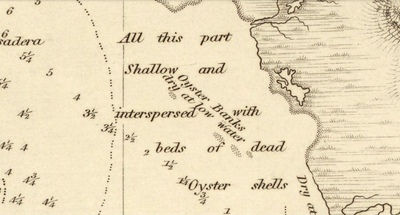
Because being a black, female, poet from Oakland who writes about the black Bay Area, what else is there to do but live through and witness the end of this era, the edge of this estuary, the sight of the flatlands and all its migrational flow washing back into sediment, knowing that
this is how all our bodies
ended up in the Bay.
***
In documenting and tracing black movement — that which is voluntary and which has been forced — I have come to rely on a moving map, one that continuously changes and shifts with the movement of the people and places and meaning within it. It differs from the cartographic standard which provides a different system of recorded names, landmarks, easements, towns, roads, distance, altitude, density. In my maps, I build a poetic and cultural infrastructure around the black memory of place, told in story, anecdote, dreams deferred, aspirations dragged asunder, generational achievements based on merit alone, the quest for better _____. It is, in every sense, a literary and sensorial map, designed for survival, for claiming reparations, for visibility and viability, for potential, for remembering, for black people. There is a port. A freeway onramp. A public housing project development. A jazz club. A free breakfast program. An intersection. A revolution. The skyline of one of the most beautiful cities this side of the Mississippi (I’m talking about San Francisco) sits looking at the skyline of one of the most hardest cities this side of the Mississippi (I’m talking about Oakland).
Their different iconographies and lateral neighborhoods reduced to
grids on other maps.
My hometown (I’m talking about Oakland) and its potholes and that decades-old joke that the pizza will get to you faster than the cops (which is still true) and the shoes thrown up over the telephone pole is not just a dot on the map, even at its exact coordinates, but a knowing and a feeling. It is the thought of one’s childhood home still standing albeit with different people sleeping in the bedrooms now and your mother no longer crying over the kitchen sink about something you know your father did (she will deny it’s about him). It is a map that records the permanence of a changing place. Of a place that has already changed. A past time. A map that shows the moment a generation of my peers, a generation of the black Bay Area and the descendants of Southern migrants, were shuffled into prisons, caught in seasons of homicide, edged off the map margins, but not before leaving new descendants who would be raised on the legends of their fathers memorialized on airbrushed T-shirts.
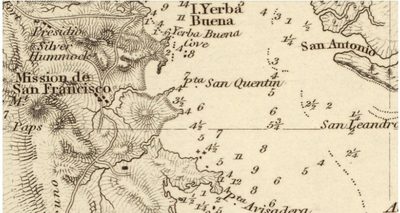
My poetics rely on the creation of an imprint of black life and all of its peripheries — white flight, the lake, immigrant populations, the bay, infrastructural disturbance, enclosures, mobilization, design, school segregation, home training, uprisings, a scenic overlook and a view of the Pacific Ocean — that is translated into geographic data — What black thing transpired here? — that is then mapped into poems. Or is it poetry that is pulled from the geographic data that helps us to map the orientation and scale of black life? I record people and events and memory in poetic form, suspended in time and grafted onto historical points that tell the story of neighborhoods, districts, street signs, overpasses, buildings, and industries. This is the same but different map that my father and his generation wrote in the 1950s and 1960s when landmarks were razed, freeways were cut through black neighborhoods, urban renewal ate through and fed the poetic potential of life and black progress in the city.