
Patterns and Tremble: On Richard Meier’s A Duration and A Companion
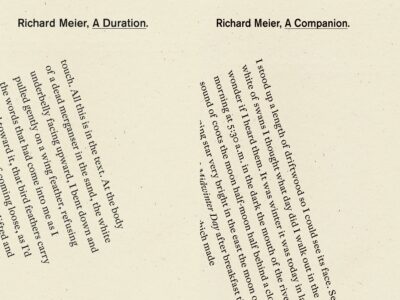
A Duration
Richard Meier
Wave Books, 2023
A Companion
Richard Meier
Wave Books, 2025
“The poetics of continuity will / deliver the mayfly,” writes Richard Meier towards the beginning of his fifth collection of poetry, A Duration. Published by Wave Books in 2023, A Duration was followed shortly after by A Companion in 2025. Over the course of two series of long-lined long poems that collage descriptions of extended nature walks, reflections on acting and writing, and the complex strata of daily relationships, Meier tracks the near impossibility of inhabiting the present moment by recognizing the brevity of an instant’s lifespan alongside the longevity of its consequence. This is the paradox of a plein air practice: the vision is uncatchable, shifting as one reaches for it. In Meier’s twin texts the reverse is true as well: patience, rehearsal, and endurance will summon the unanticipated image. The mayfly is alive only for a moment. Through rendering, the mayfly exists in duration.
The poems in A Duration and A Companion are comprised of notebook observations that weave in writing-state insights and engagements with particulars: warbler bustle, cloud cover, apple flesh, arbitrary debris. These poems attend to many presents at once by accumulating ordinary accounts and distractions (ache, oak, itch, chat); ambling is Meier’s method of inhabiting material. These are poems possessed by questions of presence and absence. When are we “here” and when are we “gone”—both necessary consciousnesses for thought. The project of both books seems to be to note the exactness of a moment while in the moment, but alas! the act itself carries you away. The carriage of language is unstoppable, poetry requiring absolute presence (but you are not present!); the poet’s task to exist a step ahead (already dead?), projecting with their song a space for the next note. In Meier’s work a poem is both transformative and incidental, the result of perception arising from the act of composition.
A Duration and A Companion are described in their copy as “poem-essays,” a term that fits as well as any other and gestures to the moments in which genres merge or divide. Meier’s stanzas move with prosaic force, occasionally breaking into stretches of dynamic sonic pattern—distant trill trembling through a forest’s mass. In “TiP TOE SOT,” from A Duration, a bouncing musicality emerges:
…The shadow is so far from its source
the branches and twist are indistinct and
overlapping, a translucent forest, the shadow a
source of heaviness and light. A robin in the
hemlock drops into flight and I see the white tail
feathers as they spread. Bitter interior time,
I too hear patterns and tremble.
In the rhyme of “source” and “forest” one hears “force,” evoking the power of the shadow’s full “o” amid the flittering rhythmic twigs of “twist,” “indistinct,” and “bitter.” “Branches” matches “overlapping” and “pattern.” A poet’s ear thrills to surrounding sounds and it’s no coincidence that the frequent natural descriptions invoke some of the more melodic moments in both books. Many of the poems include depictions of arboral lake-adjacent regions in Meier’s home state of Wisconsin, but we also move through Italy, the Pacific Northwest, and other biomes. In these poem-essays, every place is precise in its import and tethered to every other, which matters to the ecological ethics of the work. In A Duration, Meier calls these essayistic tactics “neo-realism, with its documentary scenes of life in the streets and / amateur actors” and this is one of many insights into his poetics scattered throughout the collection, each accumulating toward an aesthetic point of view only possible in transit, understanding available via adjustment and prolongation. “A small change was sufficient to change the story,” writes Meier, showing that little shifts (in life and writing) most often manifest in the particular, such as “milkweed in the process of unfurling its leaves, / the open flat flopping leaves below the curled loose thick milky / (not only when it breaks) bud, how it will spread itself thin.” Here, change occurs in lush descriptions of expansion and dilution, vulnerability and extension. One might think while reading Meier’s books of the vibrant accumulative materially-located poems of Ed Roberson, Justin Cox, Stacy Szymaszek, Katherine Gibbel, or C.D. Wright, all very different poets who might nonetheless agree with Meier’s assertion that “a serious / observation of one thing after another is a loving / action.” Meier’s work is likewise compelled by scales of attention. Place is theater—the mayfly is as crucial a character in the performance of the lake as the ice is.
While frequently occurring in rural or secluded woodsy locations, a joy of these books is their social orientation. There are friends and loved ones: James, Lisa, Jordan, Max, Chuck, Lewis, etc.; family, specifically the recently deceased Uncle Andy, whose journals are a source of curiosity; and companion texts by Gottfried Keller, Anna Akhmatova, Gertrude Stein, Bashō, Wordsworth, and Shakespeare. Speech and quotation contribute to the compost. Meier’s is a troupe poetics in the vein of Bernadette Mayer, Gwendolyn Brooks, Lorine Niedecker, and Eileen Myles. These are poems of isolation broken by conversation, disagreement, joke, and retort. A singular point of view is enlivened by response. The village contributes. Toward the end of A Duration, in the poem “Passo,” we arrive at a scene of people gathered to read aloud with one another, various in their recollection, style, and devotion:
They read the text to end without stopping,
partly remembered, and probably
incorrectly, very aware of the strange pattern of
ups and downs needed to write them. If one
dropped out, another stepped in
and read their sentences, pausing to watch the
gnats walk up and down the rough grain of the
windowsill’s pine boards. Those who had read
the entire text were suffused even after
the verb had lost its object. She studied a single
tree in the meadow…
And earlier in A Duration, Meier writes,
impermanence of the attention…
is not a measure of its
weakness but a feature of its strength, and a
potency of return.
The predicament becomes living in “this present tense that refuses no one” while acknowledging that writing from life, however fast, is writing the past. It is transforming the true-to-now into something fictitious, for “it is only in pretending that the end of pretending can come.” A related preoccupation in these books is acting—in a community theater context, in rehearsals for King Lear, specifically. Acting requires vigilant alertness, but only as one layer among many in a tradition of listening, waiting, anticipating, and (ideally, in a series of recurringly authentic presents) answering to. Observing a woman singing at rehearsal, Meier writes:
The silence of the room around a singing voice a
still singer gave me a chill in response to the
space suddenly tangible, propriocepted, part of
the body.
Meier’s poems desire something like what can happen in performance: a “trance state”—an almost automatic physical response to a real-time living context. Presence in duration is what inspires art, Meier’s work suggests, but you absent the body when writing. Can you come back to it through writing? What is the method for presence in extension? What is a form that can organize life’s show, for “the day is available and will be / performed again tomorrow”? How, in order for that form to continue, must we permit hinges for the shifts? “Nothing / provokes / Lear, nothing transforms him, nothing,” cautions Meier, King Lear a helpful warning who is “responsible but free of cause / and effect at the table while we share a soft / pretzel and three mustards.”
In both A Duration and A Companion, peripatetic delights are accompanied by the counterforce of pain related to a spinal injury that has the speaker pacing or laying on the ground in healing postures where “The / pain comes and goes, dry land, wet land.” Pain is propulsive and one clocks the body sporadically rising from the “background” of the poems to halt, interrupt, or reel the mind back “in” via sensation. Wanting the body to serve as better companion, Meier’s lines gesture to the generative potential of this tension, one that poetry can hold if not handle:
When the body doesn’t align itself
to the page and the page doesn’t align itself to the
body, when the alignment isn’t
complete, there is a conversation.
And later: “What to do with agony? Move, hardly / Move, mention the agony, count peas in a pod, / And italicize all answers?” And later still:
A big thing, the sensation
of entering one’s body, already one’s and yet it
swells on entering and in the swelling rises and
also enters collapsing and weeping.
There are also the spines of Meier’s abundant notebooks (“I’m typing one notebook, / noting what I find in another”) and the spines of the books he reads and writes. Literature is alive and requires connection, Meier shows, an idea complicated by a form (body) that’s misaligned. The poems in both books are composed of solid essayistic stanzas that frequently break their final line in the middle of a sentence in an unexpected grammatical location, enjambing over an abrupt space, the second part of the idea adrift and newly beginning its route as a recently loosened ice floe might. These poems are made of connected lines “broken” in their clumped shapes by a cross-stanza-break gap. Like walking through the woods, turning this way or that, we sort of stumble out of narrative continuation into a clearing. Chunks of prose topple from their middle into what might be considered poetry’s abyss. The odd stanza breaks become connective nothingness between vertebrae. Gaps between a nest’s sticks. Ice cracks. The country road between rural towns. Pain, pain, pain, pain—pausing thought. This pleasurable, agonizing, surprising-but-consistent splintering is at the heart of both books. The question is one of belonging or not, cleaving, or being part of the whole while continuing to fall away/struggle with the isolation of the self. This tension exists in narrative elements (relationships, nature, health, travel, etc.) but perhaps more excitingly manifests as formal inquisition, revealing itself to the poem in the process of making. Can writing be your life instead of something you do? What will move you? What combination of words will cause you to stand up? Meier desires an experience of writing that is “a kind of sixth or seventh sense // in the motion of my hand when I am writing,” and “quickly… exceeds my imagination of it, the / out-of-body experience.” Toward the end of A Companion, the speaker has a revelation about these formal intersections and divisions, saying excitedly to a friend:
…the breaks between
things are also breaks within things and the breaks within things
are also breaks between things and the simultaneous and
exchangeable nature of division internal and external is one of the
subjects of the book and also one of the great subjects of poetry…
The poems in A Duration and A Companion insist that breaks are necessary, misery is unpreventable, and continued noticing is restorative: “A tiny tear in the blanket, an eyebrow // hair, dots of ink with comet tails… Palliative care need not be for a / mortal illness.” Perceiving the bird tunes the hip. Rehearsal and accumulation create length; “presence is dynamic and various… / not the guaranteed outcome of a single / practice.”
Could these two books have been one? They’re companions, as one title states, and endurance comes from fortifying series: a chain made of daisies, a troupe of actors, a year of days, a walk of steps, a spine of vertebrae, poem of lines, play of acts, etc. You can use one book as the bookmark for the other. You can read back-and-forth, mirroring. As a reader I increasingly desire the experience of a thoughtful person’s thoughts through my days. I am energized by the drift: an accumulation of visions, a play of landscape, syntactic hijinks. Meier’s books pursue all of this by resisting swift conclusion in service of developing and strengthening, granting space in process for the entropic pause. “The persistence of our intention, as so / many times before,” writes Meier, is “to see to completion a project begun on a whim / and sure to disappear in the wind and the rain.”