
What’s a working class-poem?: On Amy De’Ath’s Not a Force of Nature
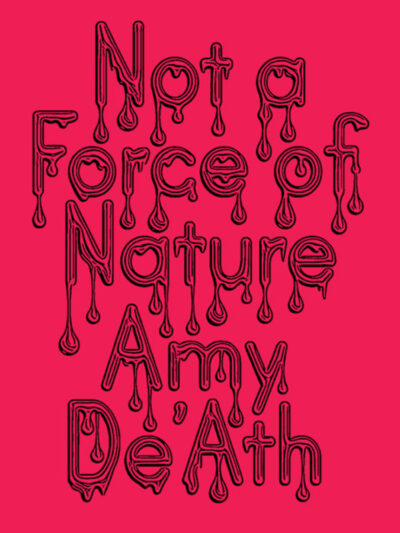
Not a Force of Nature
Amy De’Ath
Futurepoem, 2025
In a 2015 essay, Amy De’Ath asks:
What can be documented in feminist/feminised poetry that doesn’t get recorded elsewhere? What kinds of knowledge can aesthetic experience access? How might the resulting aesthetic judgments translate to analysis? How should we conceive of feminist poetry’s bearing on ‘the matter of literary-theoretical “values” and economic “value,” and could this set of questions tell us anything useful about the lives and struggles of reproductive workers?
At the time, De’ath was writing about the intersections of Marxist feminist analysis and feminist poetics, and their attendant politics, in Bhanu Kapil’s Ban en Banlieue. Indubitably, these are also the central questions that shape her own debut full-length collection, Not a Force of Nature.
Capitalism is not directly named in this collection so much as it is invoked through negation as Amy De’Ath explores materialism, feminism and the possibility of a human world beyond the market. The collection begins with “a world made by human hands, prosthetic limbs, mobile fingers” as well as the systems and “culture of ‘financial bullshit’” that results in hands at work while the body remains out of sight. It’s this impossible circuitry of signifiers that Dea’th lays out as we attempt to approach the signified:
…the actual history of women and “the body”
as if women have a body when there are no women, except there
are women, made to be there in the past and right here now in a
culture of presentism, eternally working as an orange grove does,
as a child does among SATS tests, as a person who is a hotline
after feudalism, as an image sprints back to reclaim us love will
save us love will save us love will save us love will save us
I want to know more about the past tense of feudalism––and gender and capitalism and colonialism––even as I find the phrase “late state capitalism” to be cloyingly optimistic in its implicit certainty that it will end soon. When De’Ath uses the refrain “love will save us,” both “love” and “us” are rendered abstract. The human collective is less absolute than the orange grove “eternally working,” which, of course, is a phrase that points to production, and also at effectiveness. The orange is an effective orange. But the human body is a chimera of concepts, subject to being racialized and feminized. And, without these markers, if I try to presume the body without race, without sex, without SAT scores, I still fail to imagine the “actually emboldened people who could be proletarians, farmers, peers or even homeowners or none of those but not nothing.”
Not a Force of Nature demands that the reader triangulate their relationship to just such an “us.” When De’Ath asks:
What’s a working class-poem, is it
always bitter foam or can it be just a shrug
does it lack self-reflexivity or shy away
from natural light, in Gaza they said
they were going to live right
through us and I thought they meant
spiritually: I tried to collect the working-
class but I found they had run from
themselves in all directions.
The “working class-poem” calls to mind the songs of the 1936-37 Flint sit-down strike and poems written in union newsletters. If I wipe the romanticism from my eyes, I have to admit that these poems are, with few exceptions, incredibly gendered––settled into what Rebecca S. Griffin calls a “masculine vernacular.” It isn’t by accident that the poem requires that the reader connect exploitative capitalism and exploitative colonialism. Readers must negotiate why one “discourse presumes us” and another lacks “self-reflexivity” and self-recognition. Why has the working class “run from / themselves in all directions”? Throughout the collection, De’Ath presents the speaker as a laborer redefining the self (“I thought the job would be forever”) and a “we,” a collective “ourselves/ no longer recognizable,” whose invocation must elicit some degree of skepticism. These repetitions of distinct we’s within the collection beg the question of how anyone might express solidarity when the language of solidarity is refashioned for workplace productivity––a question that De’Ath complicates further in her use of form, specifically, in a series of eight sonnets foiled by a series of eight emails.
I’m curious about the space De’Ath writes into when exploring the email as a poetic or anti-poetic form. These recursive work emails, from the worker (“Yours in a muddle,/ Helen”) to the worker (“Dear Helen”) illustrate self-perpetuating labor (“I welcome the idea we were planning to hold/ To consider a vote to welcome our ideas”) and how the “we,” who is both the signator and addressee, interrogates the (im)possibility of a work/life balance. This “we” does not compartmentalize aspects of the self but interrupts:
We do have some hands but they’re cable-tied
To a letter chiselled the 12th of September,
Tied I think possibly but I don’t think I’m getting
back to me so speedily,
If the sonnet is a form of longing, the email is a form of dispossession. I find that there’s a slight sheen or impermeability to workplace jargon, perhaps because I have trained myself to disregard this kind of language, the aphoristic motivations that enshrine labor. Still, I love the aphorisms De’Ath invents here, like “WORK THAT IMPROVES ONE IS HARD TO COME BY”. Nevertheless, each of these eight email arrangements suggest dire stakes. “I don’t think I’m getting/ back to me” is the reality of the worker’s contract, how the deliverable becomes the fixed point around which we live our lives. We are living, or perhaps, more accurately, we are being prevented from living so as to honor a conceptual output, but capitalism, as the title suggests, is “Not a Force of Nature.”
De’Ath’s collection interrogates how institutional logics make institutional structures appear as ingrained facts of the world. I’m reminded of a much loved Ursula LeGuin quote: “We live in capitalism. Its power seems inescapable. So did the divine right of kings.” Often I see it quoted as such, with the most essential part curtailed. LeGuin continues to assert: “Any human power can be resisted and changed by human beings.” Not a Force of Nature insists that we, as readers and workers, put forth not only inchoate desires but actionable political demands. What do we choose for our modes of resistance? De’Ath’s poems push us further toward absurd––an email to and from everyone, an email to and from Father Christmas––and revolutionary (“First there was piece work/ then there was wage-labour/ we should not allow this”) possibilities. In bringing the reader to a generative and speculative space, Not a Force of Nature explores the potential of “the working class poem,” and what might come after, in a collection deeply rooted in resistance.