Interview// “The Poetics of the Tongue”: A Conversation with janan alexandra
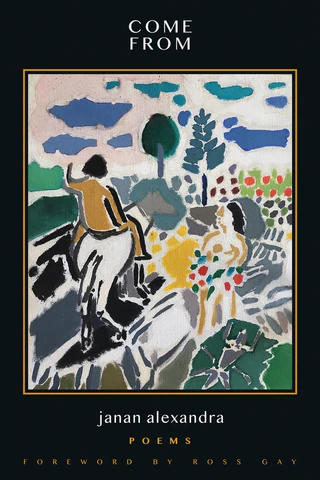
The topics and spaces of janan alexandra’s stunning debut collection come from (BOA Editions, 2025) are as far reaching as her itinerant life, one with roots scattered in Cyprus, Lebanon, Pakistan, England, France, and many corners of North America. Yet these poems are grounded by the body, the sorrows and joys that the body brings and endures. alexandra is a poet who leaps for and tends to her poems and readers with care, which is attention. I have had the great pleasure of knowing alexandra and her poems for years as we were both students at Indiana University’s creative writing MFA and we have continued our friendship across distance. This interview was conducted via email. In her responses, alexandra discusses physical poetics, the momentum and organization of a collection, and joy.
*
Noah Davis (ND): It is so good to talk with you about your first book, janan. I am so happy it is in the world.
In come from, the reader is thrust into the world of the body, the mythical world of the body, the collective’s body. Thistles sprout along an inner thigh, chicken greases the hand that tosses dinner to neighborhood cats, blood runs from the face of a loved one hit by shrapnel. What about poetry lends itself to the physical? Why is it important for your poems to be tethered to the body?
janan alexandra (JA): I love this question. Thank you. I’m trying to remember what Neruda said about poetry and objects—I’ll come back to that—but for now I think of course of William Carlos Williams’ declaration that there’s “no ideas but in things,” and I also think of Audre Lorde and June Jordan, two poets who, for me, insist on the physical, embodied, alive, culture shifting, visceral properties of poetry. That through language we transform silence into action is fundamentally a poetics/politics tethered to the body, and as you point out, to the collective body. Often it’s by naming or languaging something that we can begin to understand it, and/or to conjure something new into being. Language helps us make the impossible real. I think this is really important.
And now here comes Amiri Baraka’s “Poems are bullshit unless they are / teeth or trees or lemons piled / on a step.” Which I love! Though I’m maybe reluctant to say this or that is bullshit. But I am absolutely moved and convinced by the sudden teeth and lemons in that line. It’s the teeth and lemons that I feel piled under my breastbone. God, that’s beautiful to me. So I guess firstly I want to name, at the threshold of this question, some of the poet ancestors who are with me at every turn, whose teaching and life and work accompanies and informs my own. And secondly, I think when we’re dealing with the abstract matter of our lives and our living—such slippery mercurial stuff as thought, emotion, time, memory, et cetera—we need to ground firmly in the felt/sensed material of the world. Which is land. And skin. Which is water and weather. And sensation. And now I’m thinking too, very appropriately, of Aracelis Girmay’s poem “Kingdom Animalia” where she writes:
Whole years will be spent, underneath these impossible stars,
when dirt’s the only animal who will sleep with you
& touch you with
its mouth.
Yes. The dirt. Our first and forever home.
There are as many ways to write poems as there are kinds of poetry in the world, but it’s true that the poetry I’m often drawn to is anchored to touch and tactility. It seems to me that this is partly because touch is our original mother tongue; it’s our first technique of knowing ourselves and each other, and it is for me the site of maybe the most intimate experience and exchange. The primacy of touch as an essential technology of knowing is indisputable. How something feels in our bodies is such an important (and often overlooked, that is, from at least kindergarten we are instructed to ignore our bodies—to sit still, to eat every last bite, to cross our legs, to stop crying) source of information!
The memory and knowledge and history we carry in our senses is stunning. A scent that transports us backwards or forwards or sideways to some precious place two oceans away. The ways that our bodies are activated, god, that’s so compelling to me. And I’m really interested in the paradoxes of touch, what the critic and Black Feminist scholar Hortense J. Spillers calls “the contradictory valences of the haptic,” meaning the ways that touch/tactile experiences can be—are—simultaneously curative and violative. How touch is a portal to affection, intimacy, and of course, the erotic. But our tactile histories are equally encoded with violence and violation, invasion, theft, maiming, rupture. These are among the legacies of touch under the rubrics of colonialism, genocide, slavery, ecocide, et cetera. Both these very messed up and these very miraculous histories of touch haunt our present and so for me a poetry tethered to the body is a poetry that wants to live in that truth. To be attentive to what has been buried or hidden. Some of which is very difficult. Poetry expands our capacity to bear the unbearable, which is to say our capacity to live, and too, to celebrate our persistence.
You know, part of this is that language has always been very palpable for me, words and syllables being materials I find and feel with my body. I’ll never forget Aracelis Girmay asking us years ago at Hampshire College to say how the poem “felt in our mouths” as we read it aloud, something I now invite my own students to do (thank you, xx AG). Does it feel chunky or pointy, or does it feel like wet sand? Does it come out in a long smooth sound like blowing a horn, or is it choppy, or chewy, or watery? This is such a good practice.
And I think my experience in contemporary and improvisational dance also helps train this set of muscles—the method being about sensation first and meaning second. Literally finding sense, as in finding sensation, before trying to make sense or make meaning. When I’m dancing, I’m trying not to think or plan or predict the shapes my body makes. And instead to sense my changing relationship to space, to yield to the earliest impulses in my wrist or pelvis or spine and to follow them. To create via proprioception, which can be frightening at first. It requires befriending the unknown, surrendering to gravity, reacquainting ourselves with all our corporeal surfaces. It also invites a certain commitment to improvisation, and to bewilderment/disorientation. And collaboration. And this, in turn, subverts the usual and often brutal grammars of the state, nation state projects, citizenship projects, etc.
Am I losing the thread? What I mean is that through touch, through a poetics of touch, we reach toward each other. Our senses guide us. That’s our only citizenship. In so doing, maybe, in moving intuitively and dwelling in deep feeling, we refuse the violence of domination and conquest. Does that make sense? This is part of the revolutionary power of poetry.
ND: I admire the way you phrased how this type of poetry “expands our capacity to bear the unbearable.” Not all poetry and art does that, helps us bear the unbearable. Yours does. Thank you.
You mentioned how Aracelis Girmay asked you years ago to explain how a poem felt in your mouth, and I think that flows seamlessly into my next question. This is an excerpt I love from your poem “Homecoming, ft. Free Dates”:
The date is like god’s
toffee, god’s granny’s homemade caramel.
You can tell, I’m reformed. Returned.
Assimilation lasts only so long before
we become our mothers & conjure a way
back to the homeland, which exists mostly
on our tongues
This might just be an extension of the previous question, but the tongue is returned to again and again in this collection, often as the vehicle to explore lineage through language and food. What are your poetics of the tongue?
JA: The tongue is a profoundly sensitive part of our bodies, so that alone is worth lingering on, marveling at. All the miniscule and precise data of touch and taste and thirst encoded in the tongue. Thousands of taste buds! So there’s that.
But then of course there’s the link to language and speech. In many cases the word tongue is interchangeable with the word language. We talk about being tongue-tied when struggling to express ourselves, about something being on the tip of the tongue, which tells us that the tongue is an extension of the brain, or of knowledge/thought. (Yes, the body is the site of knowledge). The tongue (and voice, more broadly) is of course the essential instrument of the poet, whose medium is language and the singing of words. So the tongue is a very advanced technology: of speech, of desire/pleasure/eros, of mastication and digestion.
And then the tongue is also a wound, maybe for someone like me, like many of us, who have been dislocated from our mother tongues and homelands and languages and thus feel sort of inconsolably cleaved at the root. For a while I thought I was working on a series of poems called “study in my severed tongue” (dramatic title, haha) which eventually evolved into the parable sequence in Part IV of the book. Which is really an exploration of what it feels like to try to learn (speak and write and read) a language that is a home to you, but that, due to the regimes of imperialism and colonialism et al., is lost and at times feels utterly irretrievable. Which can come with a very raw shame, certainly much grief.
You know, part of the project of this book is to contend with what it means to be Arab/Arab American in the diaspora, and to often be misperceived by others. And not only misperceived by the hegemonic or White/Western gaze but also equally (sometimes more so) by the people who I most want to understand and accept me, the people to whom I want most to belong, aka my own kin! And to have the sense that my ‘unbelonging’ or my susceptibility to being an outsider is partly rooted in the betrayals of my body (literally not having developed the requisite muscles in my tongue to produce certain sounds in Arabic, for example). It’s painful.
And of course poems teach us—maybe one of the central lessons this book has taught me—is to divest from these limited notions of belonging. And to resist myths of legibility or wholeness and instead dwell in our fundamental illegibility. The soup of mixedness, plurality, shadow, and tatter. To work hard and lovingly at inhabiting fragmentation. It is a condition of our time. So in the poem you mentioned, part of the work of the tongue is to befriend a certain kind of exile, to plant as many kisses there as I can.
There’s so much beautiful and powerful scholarship about this stuff, so I’m just joining the chorus. I want to take up your question about food and lineage, too. I know that’s something I love in your own work. I’ll never forget your poem about your grandmother’s turtle soup. I think for many of us in the diaspora who have lost some of our original languages and homes and lands for all manner of very real and often messed up reasons, we are sometimes most fluent in the kitchen. And nourishment, well of course this would be a site of intimacy and care and struggle. So much personal and collective history. Stories, recipes, foodways. How “we” do things in “our” part of the world (cue my mom!). You know, my mom is sort of a formidable cook, as many moms are, as many Lebanese moms are, and being with her in the kitchen is maybe my oldest home.
And our mothers are the first source of nourishment, their bodies our literal kitchens when we’re in utero, and when we’re out of it too, so I think there’s a lot of stuff there. And lastly, I think, back to the poetics of the tongue, the kitchen is also the place where my Arabic is most intact, my kitchen Arabic is great. Probably most of my Arabic vocabulary has to do with food and eating! Which is kind of lovely and special, I’ve come to feel. Even though I can’t hold a conversation in Arabic, parts of me live incontrovertibly inside of the language. This language that’s so intimate to me, that when I hear it I feel I belong to it, when two guys are speaking in Arabic on the sidewalk I want to stop them and say I love you so much. And I am yours. And my name is also your name. And yet I can’t actually tell you what they’re talking about! It’s a real trip. It’s wild. And so food is a great connector. It’s another language that’s available to us—cooking for folks, feeding people, being fed. Teaching someone how to core kousa or roll grape leaves. That’s a serious poetics of the tongue, too.
ND: “Being with her in the kitchen is maybe my oldest home.” I am very drawn to that. And I felt the sorrow when you mentioned the betrayals of the body. I think that lineage that you’ve shared, the wound and the healing of language, is so apparent in the fourth section of the book. This series of poems titled parables—“parable of the field,” “parable of broken bones,” “parable of the eye in the throat,” etc—all careen with the motion of sound and language, of energy and play, of questions and sorrow. Can you speak to this momentum and reflection?
JA: I’m so glad you asked about this sequence in the book, it’s one of my favorite projects and simultaneously it’s the section I’ve felt the most doubt, curiosity, wonder, and vulnerability about. I guess it felt risky to me on a couple of levels. One, it makes very apparent all of the loss I carry in my relationship to my mother tongue, there’s no hiding it. And I guess that feels exposing in a way. But my hope is that it’s a balm for others who share that experience.
Secondly, it’s a more experimental sequence, meaning that the poems don’t rely on familiar forms. There are patterns and strands that emerge throughout, but ultimately it’s a sequence that asks us to read lyrically. To make “lyric sense” which is different to, say, some other kind of sense. And there are stories woven into the parables, there’s certainly a seam that runs across the entire section, but I think many readers will have to do a little more work to find their feet as they read. It’s very interior, kind of polyvocal. There’s a lot of ekphrasis happening too, some of the poems written around the sound of a particular Arabic consonant while other poems are crafted around the shape of the letter, the visual aspect of these marks on the page.
Hopefully it’s cumulative and instructive, that is, hopefully the parables teach readers how to read as they go. But for the non-Arabic speaker/reader it’s probably somewhat uncomfortable, maybe frustrating, to encounter language that they’re unable to read or translate. And you can’t exactly type it up into Google Translate unless you’re familiar with Arabic script (though with all the AI stuff there’s probably some easier way to translate) but still. It requires one to slow down, to linger over this or that shape, to practice making vocal and to practice not knowing how to make the sounds. To read multidirectionally. It’s labor intensive. And so the parables reproduce the sensation of being outside of a language, feeling that barrier, working slowly at the edges.
And in some ways this section is maybe a little more cerebral, the poems are very interested in etymology and roots and linguistics and translations and mistranslations. It’s gestural and fragmented, and that’s maybe the point. Going back to some of the words in your question—careen and play and reflection—I think the parables liberated me from having to tell a linear story. They gave me room to improvise and to unravel many stories at once.
ND: Yes, there was an unraveling, and unfurling that occurred. And what a skill to teach the reader to read in the middle of a collection, which I learned and loved.
You’ve already talked about the multitudes that touch holds—affection and rupture—but now, more broadly, what is the balance of sorrow and delight in your poetry? So many of these poems hold both with outstretched arms, simultaneously offering the reader to look at each with reverence. With your themes of inheritance, family, and deep attention to the world, how do grief and delight inform each other?
JA: This is maybe the question to end all questions!!! Meaning, actually, to begin all questions. To begin to answer. To keep asking this question. I am grateful for this conversation with you.
I guess I would maybe just say, because there’s no other way.
Because the work I’m trying to do in poetry is the same work I’m trying to do in living.
Which is to attend deeply: to listen and look. To imagine and create and revise.
Which is also to insist on “having and keeping a beautiful mind amidst old and new catastrophe,” (Nikky Finney’s words, embroidered on my heart).
They want us to think all is doom and doom is all. To feel defeated, distrustful, miserable with fear. And so to insist on the daily miracles in our midst alongside the terror is to join a long history of love & refusal! Mary Oliver reminds us that “the world didn’t have to be beautiful to work. But it is. So what does that mean?” This is a good thing to wonder about every day.
To be able to hold it all.
To expand our capacity to bear our own suffering, which helps us bear the suffering of others.
To tolerate the intolerable.
To dwell in need.
Which is difficult.
Which requires curiosity.
Which is relational.
Which is how we survive the great ordeals of aliveness.
Sometimes against many odds.
Which is how we aid in the survival of as many others as we can, no matter how small.
Because, as I was telling a student the other day, who didn’t want to write an ode because he said how can we praise anything in our rotten world? And I said well, yes! Exactly! The ode doesn’t deny the rot and misery. The ode precisely declares what is praiseworthy in spite of, alongside, in light of, what is lost, destroyed, broken, etc.
And our rage is a clear-eyed call for love. Our fury and our grief are signs that we love. Rage and grief are perfectly reasonable and healthy responses to all of this. And it’s not the opposite of love or delight. It is—and here I’m really indebted to Ross Gay and so many other beautiful writers/thinkers for helping me learn and practice this—joy. But a politics of joy, not the plastic joy of a presidential campaign. A politics of joy is to be in the wilderness of our need, and grief, and our sacred rage. To interdepend, and to integrate into our lives the interdependence of grief and delight. That’s what will see us through.
And all that we love, as I said somewhere above, will vanish from our fingers. And our fingers too, will vanish. At least on this plane, in this form, this iteration. And so. To walk with our arms outstretched toward it all is to insist on tenderness. And risk. To be vulnerable, which means to be woundable. Would that we all might be more woundable. Can you imagine that?
ND: Oh, that answer is beautiful. I believe so fully in that answer. Thank you so much for this conversation.
In closing, is there a poem, or an excerpt of a poem, from come from that you’d like to share? Where would you recommend for readers to buy your book?
JA: Oh. I would love if folks wanted to buy come from directly from BOA Editions, who do such good work on behalf of writers and readers. Or you know, maybe requesting it at your local public library or book store, or ordering it from one of the less awful places like bookshop.org.
I’ll leave you with this poem that emerged in the early days of the COVID-19 pandemic, in a beautiful and sort of urgent exchange with the writers Austin Araujo and Ross Gay. We were all of us reeling with the loss of touch in our lives/worlds, the social distancing and fear and digital everything and alienation and ongoing states of catastrophe. Ross asked hey maybe why don’t we write some epistolary poems about touch? Which was so smart. And this came out of that, and with everything I said about touch earlier, and as the songbirds awaken, and as daylight lengthens, this feels right, maybe.
Notes on Touch
Sure, life also includes staring at ice flakes
in thawing compost, sweeping debris.
When I push the broom across the floor,
dust springs alive. I am here as you are there
somewhere. Together we miss the touch
of the world, beautiful & awful. But still,
the birds aren’t closed today. The birds
don’t stop their happy racket. This robin
just flopped down in the grass by me.
When I speak, her head twitches. I wish
she would climb into my hand, I wish it
silently in my heart. It is invisible but near
constant, the urge to touch. To make
& learn by feel. To be known by hand—
what else is there! Some want sex twice a day
& others have lost all desire. Regardless,
the walk across the yard is still the walk across
the yard. Everything keeps on, lives & squeaks.
I scrub the mudroom & find moss dotting
the stone steps like stubble. I love it as I love
every face as a face I might press my cheek to.
“Notes on Touch” first appeared in come from (BOA Editions, 2025). Reprinted with permission from the publisher.