
Interview// “Magic is Gone”: A Conversation with Jack Saebyok Jung
Jung’s debut poetry collection, Hocus Pocus Bogus Locus (2025, Black Square Editions) is exuberant in its sonic play and sharply attentive meter. Jung transforms family memories, warzones, and urban landscapes into rooms where Biblical figures and aliens roam on equal footing. Children recur throughout, overseeing the creation and destruction of fortresses and trees. Jung threads the connection between personal and political histories into an explication which resembles a child’s loss of innocence, or the passage from one country to another. We spoke briefly over Zoom this fall about the English Renaissance, Tommy Lee Jones, and living between languages. I was Jung’s student at Davidson College as this book came out, and was eager to ask him about his brilliant debut after graduating.
*
Brigid Regan McCarthy (BRM): The collection begins with an origin story, “I Come From A Country.” It is a metaphysical birth which at times seems to be told from the perspective of a new soul:
There was no difference where I went.
………………………………………………………………………
Black tides of a newborn swelling,
I prayed to be where I wanted to be from.
Can you tell me about this book’s origin story? Where does it begin for you?
Jack Saebyok Jung (JSJ): Oh gosh. That first poem, “I Come From A Country,” those four stanzas, those four sestets, are surviving pieces from a project that I did when I was an undergrad, my senior year. I did not get to do a creative thesis like you did, but I was still interested in putting together something for myself. And after a lot of trial and errors I tried these six-line forms. Maybe it was because I had been studying a lot of Renaissance English poetry, so a lot of sonnets. Sonnets, as you know, have the parts that are octets and sestets. I was also looking at a traditional Korean poetry form called sijo, which hasn’t caught the imagination of Americans as haiku does, but it’s another six-line form, or three-line form, depending on how you write it. It used to be a song, a lyric form, but at some point in the 20th century, it became a written form. It also has those moves where you tell a situation in the first line, you expand on it in the second line, and then the first half of the final line, so in the penultimate half line, you twist the situation, and then in the final half, you resolve it again. There are, of course, other syllabic requirements and rhythm requirements, but I was more thinking about those structures, and I kept writing those. I ended up writing 100 of those over the course of the senior year, 100 six-line poems. I liked doing it, but then I gave it a rest and didn’t really revisit it until many years later when I was at my MFA program.
After looking at those hundreds, I realized that most of them were really bad. Those four are the remnants of that time. So those four I saved, and initially I thought each of them would be individual poems. But after looking at them and putting them together for a while, they form a fragmented story. “I Come From a Country” as a title used to be only the title of the first piece. And then it became the title for the whole thing.
That was the origin story for that, and actually, some of the poems—in the first part of this book, especially—come from a time from college up until my starting of my time at Iowa, so it’s poems all the way from 2010-11 up to 2024, when the book was finally being put together. I am surprised to admit it, but yeah, the book took me about 13 years to write.
BRM: More on your relationship to form: would you say that you rely on it? Or would you say more that you try to challenge it?
JSJ: My sense of where form is in American poetry now is that you can either choose to put it up as your shadowboxing partner or you can ignore it. What I mean by “form” is a classic sense of iambic pentameter, sonnets, villanelles. The other way of thinking about form is that you find the form for that particular piece of writing that you’re working on. But when we think about form as something that’s part of the tradition, very patriarchal, something that’s coming from our institutional education, then you might even feel like you’re struggling against it or fighting against it. To me, when I was starting out in college, these kinds of forms from Shakespeare to Milton were completely new to me. I had no background in English literature until I got to college. I’d never even thought about writing anything like this, so it felt new to me. It wasn’t a pressure that I was under to perform in a certain way. In my high school experience, we read a lot of fiction, but the only poetry that we ever talked about was one poem by Edgar Allan Poe: “The Bells.” So, yeah, poetry whizzed past me until I got to college, and then I was like, “wait, people… write poetry still?” That was my reaction.
BRM: From your poem, “Robot”:
Lobotomize the robot at the bottom
of the castle holding the lantern of atomic patterns
turning to the sea like a hobo in a Gonzo.
And, from “City of Light”: “Gorgeous as a bourgeois vacation in Paris / where perennial discretion is discarded.” What drives this wordplay? Is it that—play?
JSJ: “Robot” and “City of Light,” they come from a very specific period in my life: the last semester at my MFA program at the Iowa Writers Workshop. You really begin putting your thesis together in your final semester. Your first manuscript, right? And I had all these poems that I’d written in my two years, and I was not happy with any of them. They sounded very . . . clean, minimalist, almost anti-word play, relying on inventive line breaks. Or . . . playing around with meaning, but mostly based on imagery and very quiet forms. By “quiet” I mean the craft was mostly invisible—image-driven, sonically restrained—the kind of poems that try to get out of their own way, nothing loud happening on the surface.
I had taken two seminars. One was “Poetry and Sound” with Mark Levine, and the other one was this classic survey of English prosody with Jim Galvin. And the real first poem of this style that I wrote was a poem titled “Hammer.” We were going all the way back. The alliterative meter, the repetition of all those consonant sounds, and the four beats, that is something that English poetry . . . before all the French, Latin, all the mixture came about through invasions and whatnot, this is what they used to do. This is what Beowulf was written in, and no one really does it anymore. And if you do it now, it almost feels like nursery rhymes or children’s poetry. I was just sitting there, saying, well, I’ll just try it, but then I’ll try it with words that I’ve never used: “Feeling extra technical O most lyrical / almost an extraterrestrial terraforming fanatical” (from “Hammer”).
These were words that I would have avoided. These adverbs after adverbs, all the Latin, technical words, I was like, “I’m not gonna use them in poetry,” and then something just clicked. Why can’t I use them? Why am I telling myself that there are these rules? So maybe this is going back to your form question. Something perhaps grows inside of us when we start learning poetry, and then we tell ourselves, “this is how you’re supposed to write, this is the language you’re supposed to use,” and I had a breakthrough, where I said, “no, I’m gonna just use all the words that I’ve ever known. All the words that I just stopped myself from using, simply because I don’t think they’re poetic.”
I was initially really scared when I wrote these. I was like, “oh god. These are perhaps really bad. I don’t know how to think about them.” And this is advice I gave you once: maybe you should try to actively write a bad poem. You can’t start there, because you need to have been struggling and learning. And then, at some point . . . It’s not perhaps even confidence, but more a necessity to break the rules. Then I showed it to my thesis director, Mark Levine, and the first thing he says is “this is the best thing you’ve written.”
BRM: You mentioned how these poems, the “wordplay” poems, might have the sonic effect of a nursery rhyme. We talk a lot about the intention of a poet, and how futile it is to even guess at what force drives our own poetry, and whether or not we’re aware of the meaning we’re making as we write it. But that being said, children appear all over this collection. Two examples that really stood out to me are in “Battle Royale” and “Complex Playground.” In the former, the speaker is bearing witness to the construction of a castle that he cannot enter, whereas in the latter, children are destroying a sandbox city. There’s this moment at the end of “Complex Playground” where you can see that there is a distance and discrepancy between the child’s lived experience and the retelling—and reinterpretation—by an adult:
as neglected as an emperor’s tomb.
Children get home.
Until dried dirt is soaped off each face
parents don’t know.
It is very ephemeral, this moment that the children are sharing, because once the parents “know,” it is written off as play and cleaned away. In your collection, however, your poems are indebted to childhood, play, and parenthood as much as they are to war and the relationship between personal and collective history. What was it like to reckon with those very disparate themes? Are they connected?
JSJ: I think it’s one of those things where until someone points it out to you, you don’t realize that you’ve been doing it. In one of my blurbs, by Kim Hyesoon, she says something along the lines of, “Inside this vortex”—she was talking about the whole collection—“lives a pure-hearted youth, gazing directly at the poet.” She gave me the blurb in Korean, so I translated it myself, but “youth” could have been actually translated as “a boy” or “young boy.” I feel there’s this sense of how I must be feeling connected to my past. There’s this child that I was, that I’m looking back at. It might be because of my experience as an immigrant. Moving from one language to another, there’s a sharp break that happens between. Another thing is, this sense that I’ve always had about being . . . haunted might be too strong a word, but I can’t find another one. I’m almost haunted by what could have been if I had stayed in Korea. So there’s this parallel universe of this other Jack, who probably would have never used the name Jack. And then there’s me. Mostly, it’s just this idea of a severed connection with the past that makes me look back at this child figure and think about how disconnected or how different I am from them. So, the poems usually end up becoming an exploration of that.
BRM: There are also so many poems that depict, either directly or through metaphor, mother and child.
JSJ: Obviously, the mother-child experience also becomes really key, coming from a very classic indebtedness that many first- or second-gen children feel towards their immigrant parents, and the sacrifices that they make. Immigrants, diaspora—the more you study, the more you learn about the world, the more you understand how much of all these movements of people are connected to the history of the world, violence, colonialism, wars. It almost naturally leads into thinking about these bigger, grander themes that are so closely tied with our personal lives.
BRM: Thinking about your work as a translator and your experience as an immigrant, how do you make sense of language and cultural barriers in your poetry? And how does your work as a translator influence your poetics?
JSJ: That’s another thing that I’ve been thinking about: whether or not I have any sense of a set rules about how translation becomes part of my writing. Going all the way back to college, my first poetry teacher, Jorie Graham, she’s also a multilingual, trilingual person (French, Italian, and English). She had a poem titled, “I Was Taught Three.” She moves through different names for a chestnut tree, in French and Italian, that the speaker is looking out towards. The ways in which different languages form different perceptions of objects became a way for me to think about the words on the page as not just signifiers of something else, but as objects themselves. Brush strokes, or the imprint of a sculptor’s hand, or some chiseling. You can think of words not just as tools for communication, but also as materials that you can play around with. And that’s probably one of the reasons why some of the wordplay became so prominent, because I was looking at them more like materials.
What’s interesting about that, though, is you can’t really, completely separate language and its role as communication tool. So it does carry meaning still. No matter how much I would like to say, “oh, yeah, this is all brushstrokes, it’s all vibes, man,” it does still carry the history behind all that. So as a translator, you’re always dealing with the texture of words, but also with the history of words. You’re trying to carry those things across, and often we can’t really carry everything across. Probably never.
We can then say, “well, it’s impossible, and especially poetry that relies so much on both the history of the word, the meaning of the word, and also texture of the words, the translation is always going to be a poor copy.” I think when I was younger, I definitely subscribed to that, until at some point, I think I just changed my thinking about it: if you can read the original and find the path towards some type of truth, or some type of emotional reality that the poet achieved, and if you can really closely experience that, then it might be possible to replicate, or even create a version of that experience. So it’s less about, “this is the dictionary definition, and this is the word order, and this is the sentence structure that you should bring across,” but you’re trying to recreate that experience using different tools altogether.
Another way of looking at translation via a childhood memory: I would see these expensive toys. Of course, LEGO is also an expensive toy, but you still have LEGO pieces that you can do whatever you want with, so I’d destroy the LEGO models that I had to make these toys that I didn’t have. To make it look like Gundam robots, or these castles that I saw. I’m using materials that I had in order to create something that I wanted. Maybe that’s something I’ve been doing for a long time, now that I think about it.
BRM: I noticed the collection’s interest in Greek and Roman myths as well as Christian mysticism. Was there any equivalence that you were trying to create in those distinct mythologies, or was it just a way for you to play with history and shared cultural understandings? Figures like Lazarus and Orion and Artemis are familiar to so many people.
JSJ: I don’t know if I had a clear idea of my cosmology in that sense. I can explain some of the ways in which I think about Christian or biblical mythology.
I ended up writing my thesis on Milton and Paradise Lost. He has the scene of all the fallen angels mustering as their commander, Lucifer, calls out to them. They’ve been defeated, they’re rolling on the fields of hell, burning in this flame that is not giving any light, and everyone’s just basically screwed. They tried to rise up against God and then they got their asses kicked. But when they gather, it’s actually lists of all these pagan gods. And you even see anything from Ashtaroth to Zeus and Jupiter. All the gods are there. Milton would have been, at this time, very much into the study of occult. The way he probably approached occult or mythological thinking was almost like a study of science, rather than something that’s esoteric and strange. All that is to say, the way he and 17th century Renaissance people thought about magic and whatnot wasn’t necessarily that any of it—the gods, the occult, the supernatural—belonged to some separate category called “magic.” It was part of how the world worked. Like, when he wrote about Zeus being Jupiter or all those other gods being fallen angels, he wasn’t writing in a symbolic sense. He literally believed that to be the case. Magical thinking as such was never thought of as magical thinking, it was a lived reality. People believed in fairies. Well, they didn’t even believe in fairies, they knew fairies existed.
We live in a time where that’s practically impossible. Faith, for most people, is a private thing. Of course, there are political groups sometimes—well, often these days—who want to impose their faith at large, but for almost a few centuries now, religion has become personal, familial, and in that sense, separate from how people tend to experience the world. The world has become much more secular in that sense. We have evolutionary theory, we have a world that’s no longer 6,000 years old, it’s millions and millions of years old. So magic is gone. When I’m citing these things, I’m trying to think about, well, can they come back again, in any sense? Is that a possible way of thinking without becoming, well, hocus-pocus? Without becoming pure nonsense, wishful thinking? To go beyond a modern fantasy, like Tolkien and whatnot, to go beyond make-believe, but talk about them as if they’re still active force? How do we have magic again without falling into superstition?
BRM: Or conspiracy.
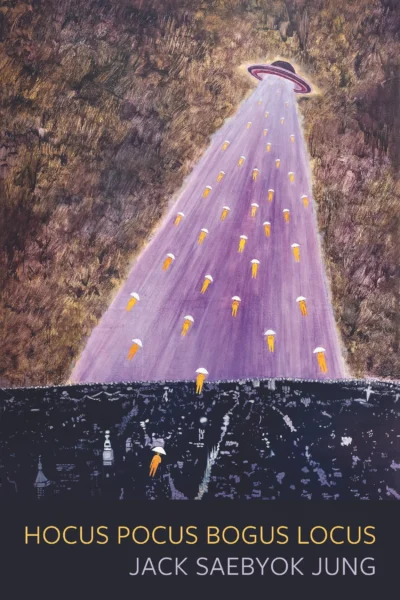
JSJ: Speaking of conspiracy…. UFOs. (Jung points to the cover of his collection.)
BRM: Speaking of UFOs, before this collection, I had only read the first “Pitch” poem. You’d shown it to me once during one of our workshops. I didn’t realize it existed in a series. Did you write them one after the other?
JSJ: The origin story is quite funny. I like watching these old commercials. Sometimes a really good commercial has the rhythm of a poem. Then you realize that, basically copywriters are poets.
BRM: “There are things we must do to make a living” (from “Pitch”).
JSJ: You’ve really dived into the collection, thank you. So I was watching this commercial of Tommy Lee Jones. For some reason he ended up doing these canned coffee commercials in Japan. The role was that he was an alien who was visiting Japan, or Earth, but he decided to go to Japan, and he’s learning about humanity and how they behave. I basically was like “Yeah, I’ll take that and then I’ll write a poem on it. I’ll just change the sex, I’ll think about someone else other than Tommy Lee Jones.” And then that became the basis for the first “Pitch.”
Later on, a friend of mine handprinted the cards for the “Pitch” poem. Kate Gibbel, she runs Send Me Press. She handprinted all of them, and then she did a reading. She held a reading for all the poets she published in New York, in Brooklyn, at Unnameable Books. When we met just before the reading, a week before the reading, she was like, “what are you gonna read?” And I was like “maybe I’ll write a series of ‘Pitch’ poems.” She’s like, “maybe you can write seven.” So yeah, that’s what I did, and then that’s where all the other pitch poems came from. I was like, “I’ll just follow this character.”
BRM: I really liked the repetition of “disguised as an American.” The idea that the alien in these poems is encumbered by American-ness, as if it’s a mask. My million-dollar guess would be that that comes from your experience as an immigrant.
JSJ: Alien as a metaphor for being an immigrant was perhaps way too obvious, right? One thing I’ve learned is that when something is really too obvious, or someone would roll their eyes at it, just lean really hard into it, then turn. Chase it to absurd lengths, until you can make it feel new again. The repetition was one of the ways in which I was leaning really hard into that. Another thing was, the idea of an alien in disguise. I wanted that sense of hiding and disguise to almost be complicated or to disappear as the poem went along. A space where the actor could no longer be an actor, and the voice actor gets trapped in her in the video game that she worked on.
BRM: Having been your student, I took a keen interest in the poems in this collection that dealt with being on both sides of the student-teacher exchange, and I thought “Code” was a poem that questions authority:
Inside the teacher’s office
is a slab of stone, roughly chiseled
……………………………………………………..
He demands I see a dolphin
where he sees one.
And then you have “Nurse II,” a poem which opens with the speaker’s mother thanking Korean War vets. The speaker “sees” his students in another life, another circumstance, a parallel universe, fighting a war as young and teenaged as they are now in his class. I assume as a reader that “Nurse” and “Nurse II” are poems about your mother, given that you dedicated the collection to her. Where in your mind do you link teaching, authority, and parenting? You’ve already talked at length about being a student, and how being a student has influenced, of course, the way your creative writing journey has developed, but how has being a teacher influenced your poetics?
JSJ: Good question. When it comes to teachers, I’ve had some really amazing, great people, and others that I had a hard time with. My thinking, as a teacher, is that I would want to be the type of teacher I wish I had. And my end goal would be to help someone by guiding them to a place where they don’t necessarily need me as a teacher anymore.
Authority, respect, and power dynamics between teacher-student relationships, in college or in other settings, it’s I think maybe unavoidable, but it isn’t exactly always going to be problematic. It’s just how you wield that power, or how you diffuse, or divest that power, or just share that power in classrooms.
In poems like “Code,” it actually flips the table where the student feels like they’ve actually failed at a greater scale, because they’ve let the teacher believe in this fiction, this lie. And that becomes an even worse crime than the teacher demanding the student see something the way he sees it. I was thinking about how teachers are probably at fault too, but what is my complicity in that structure? Will I just allow the teacher to be that way? Is there a way to transcend that? In that poem’s last moment, maybe. I can’t see the dolphin, but maybe I can become a dolphin?
A writer, a Korean writer friend, recently pointed out to me when I showed her this poem, “Were you playing with the Korean word for dolphin?” I was like, “what do you mean?” Because it’s 돌고래 (dolgorae). 고래 means whale. 돌 on its own is stone. Stone whale. I was like, “Holy shit, I was not thinking about that, but I’m gonna take that.”
BRM: Don’t you love it when you surprise yourself?
JSJ: That makes me sound so much more smart. I don’t have any right to be so. Yeah, so there’s that angle of it that I hadn’t thought about, but yeah, it does exist. So if I ever translate that poem into Korean, it’s gonna have that aspect.
A shorter way of saying what I’ve just said is, like, being a teacher, or maybe even being a parent is, to an extent, working towards giving up those powers, ultimately. You have to get to a place where you no longer really need to be a teacher.