
Docudocupoetics: on Erin Marie Lynch’s Removal Acts
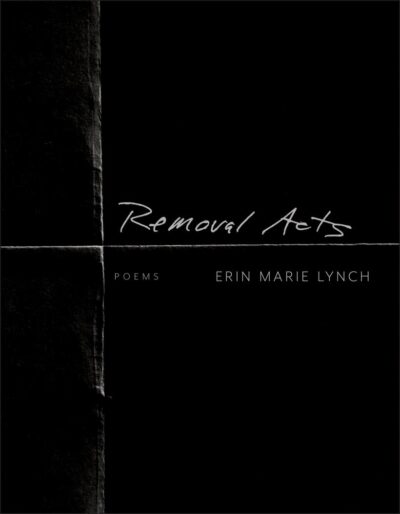
Removal Acts
Erin Marie Lynch
Graywolf Press, 2023
***
At the end of “Screenshots,” the final poem of her debut collection Removal Acts, Erin Marie Lynch appears in a series of stills from a video of herself where she dresses and undresses in a garment left behind by her great-grandmother Lorena––“a ‘ceremonial gown’ meant to resemble traditional clothing of Plains Indians.” This visual experiment has already appeared much earlier in the collection; in the text of the poem “From the Archive of American Object Lessons,” Lynch notes: “2020—I set up a tripod and record myself putting on the dress and taking it off, over and over. Watching the footage, I’m startled by how much I look like her.” This singular physical garment occasions both pieces; its result is multiple works that witness the witnessing of the object, and the effects of this witnessing.
In a 2023 interview with Montserrat Andrée Carty, Lynch said of her book: “I wanted to make a document of my experience of experiencing the document.” I copied this explanation into my journal, then wrote underneath: docudocupoetry. This doubly compounded word has multiplied throughout my notes since my first encounter with Lynch’s collection, sometimes appearing in an abbreviated echoic form as docudocu.
It is the recursive nature of Lynch’s statement—and of my resultant shorthand summary of it—that has held me in a state of continual (re)reading of Removal Acts since its release in 2023. My infinite loop with this book is influenced by its own logic. Its first section, Foreword, contains the sole poem “To This I Come”, which arranges origins like paintings stacked one on top of the other. As the “From”-places gather, they recur in varying degrees of sharpness and blur, shifting focus between material reality and known unknowns. Recursion then bookends the Afterword of the collection. In the first poem of this second section, it arrives immediately as an imperfect Droste effect: “saw myself in the mirror / then turned away, thinking, seeing herself / naked, she turned away”. This is the docudocupoetic gesture at work.
“Screenshots” offers several other such processual testimonies, perhaps the most striking of these is the lone unbracketed section that hugs the perimeter of a photograph of Lynch’s great-great grandmother Elisabeth. In the absence of image, we are starkly in the presence of a witness present to her own limitations: “I cannot touch you. Cannot know your mind… I cannot quite.” As the lines begin to “over and over” themselves, they overfill the volume of their container and cannot fully complete their repetition.
Over and over, the meta-attentive “I” is conscious of herself and her reiterations; so much so, she nearly achieves the impossible: to catch her own eye seeing itself as it busies itself with seeing the many voids that populate these poems. Voids like frames, whiteness, ink dots, zeroes, and the “no-/longer-knowing” that “is the State’s project—” Each vacuum manages somehow to cast a shadow in spite of its formlessness, which suggests that its form eludes capture except in the poet’s attestation. “Up close, creases under his eyes, hooked arc of his nose, his broad upper lip all dissolve into ink dots. Asset number 645095001. Each dot a droplet. Each dot void. Each dot sovereign.” So reports Lynch in the first “Removal Act” as she examines a print-out of a screenshot of a copyrighted image of her great-great-great grandfather Mato Sabi Ceya. Docudocu.
Although it isn’t quite a void, one symbol of absence recurs about two dozen times throughout the book. It is first introduced in a line in the poem “Bloodlines”: “[ ? ] standing / for the missing, / born and dead”. It then recurs most noticeably in the series of poems titled “Figure [ ? ]”—seven interventions that host other interlocuters whose texts Lynch borrows from to make sense of her artmaking. How can presence, in the face of so much absence, facilitate the insurmountable work of reckoning-with?
In her answer to this question, Lynch turns to a method that Cristina Rivera Garza calls “necrowriting,” a theory and poetics of disappropriation that I find enacted throughout Removal Acts. Rivera Garza describes this poetics of disappropriation as a “writing with and through others” wherein the writer embraces the work of one’s peers and predecessors, and rejects the individualistic notion of intellectual production upheld by neoliberal logics of ownership and competition. A poetics of disappropriation welcomes haunting and assemblage. Put another way, a disappropriative text is recursive—it does not exist without the collective, and it is always being made and remade by and in an eternal accumulation of texts. This is how necrowritings are composed, as texts that resist the culture of war and mass death that coerces us constantly to leave our dead and missing behind so we may remain fixed on producing the future tense of profit.
There is no speaker in Removal Acts that disengages herself from the debt she owes to her teachers. Living and dead, these guides are more than just acknowledged or cited, they are engaged in an ongoing conversation that ranges in tone from avoidant and impatient to celebratory and self-effacing. These interlocutor-guides include Paula Gunn Allen, Mahmoud Darwish, June Jordan, Bhanu Kapil, Fred Moten, Sheila Heti, among may more. They are various, interjecting with their unruly and buoyant lines, and carefully selected by Lynch to enrich the document of the document that she is producing. In this series of poems, we see how disappropriation emboldens the poet to do again—not just writing, but also hauling [ ? ]s along with her. From the seventh “Figure [ ? ]”: “In other people’s words I sought some sound to follow. In the peal of their perfect phrasing. To follow where. Embarrassing, this urge.” But then: “May my embarrassments oft open me.”
I write this from an unnumbered reread of Removal Acts. My experience of this collection has never felt finished, perhaps because nothing of this book comes to a neat end—not the poems, not the archival materials that guide them, and certainly not the poetic inquiry that turns in on itself to again and again question its own efficacy. Still, I am carried by a lapping current through this docudocu text, in this document of both document and documentary. It represents an origin inasmuch as a calling or destiny, not just a homeland or birth year, can be understood as an origin. And from that origin, many movements, removals, and also recursions, returns. This is how Lynch begins: “From the claim I lay to those no longer with me—” The documentary gesture, when enacted as a concerted effort to speak with the past, insists on accumulation—the gathering of our dead, our shed selves, our histories of abjection—and our eternally witnessing eye fixes on all that we’ve gathered, gathered around, are gathering round.