
Interview// “Oh My God, My Lawn”: A Conversation with Nathan Hoks
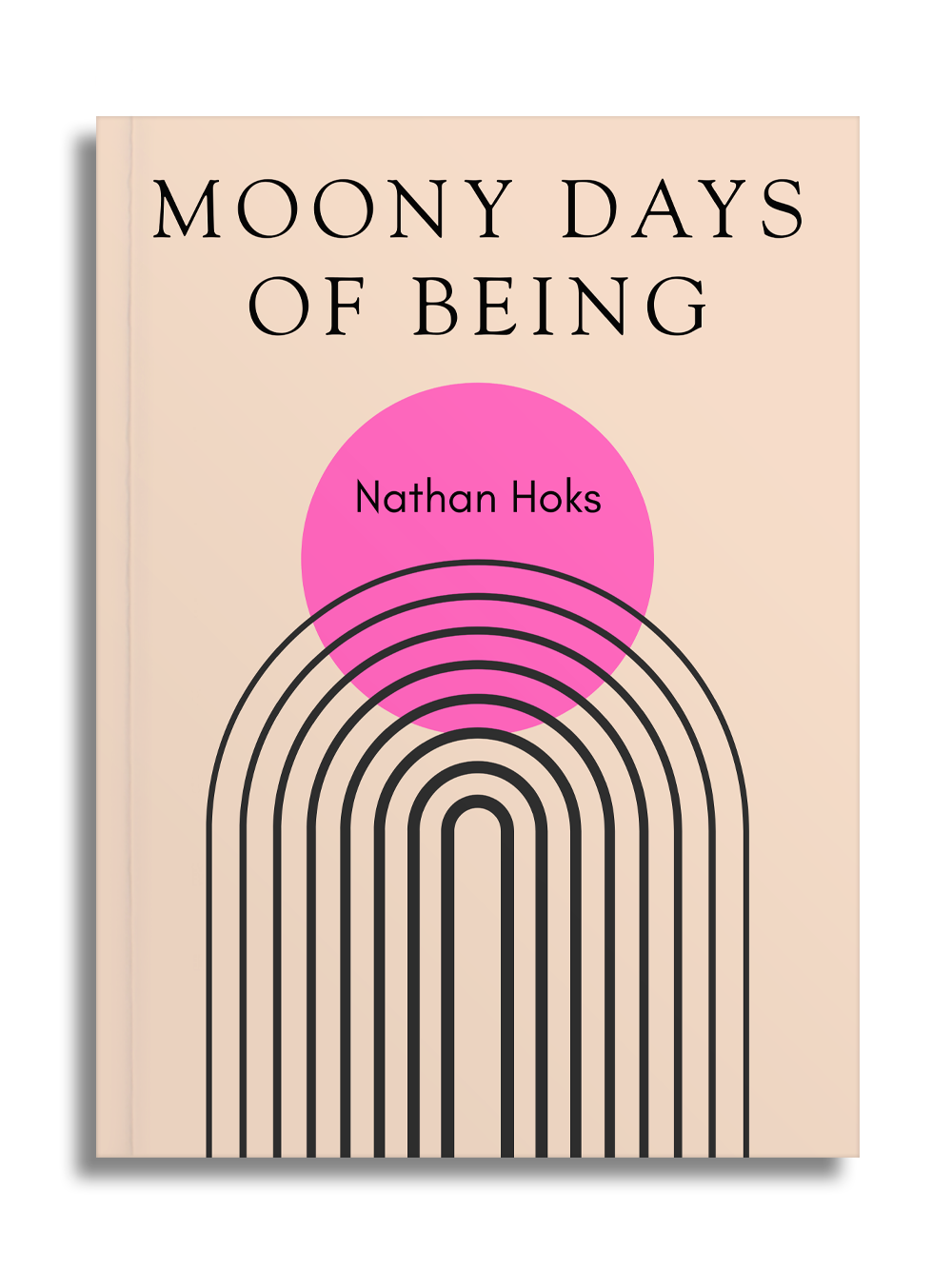
Nathan Hoks’ fourth collection of poetry, Moony Days of Being (Black Ocean, 2026), is a humorous, deeply felt book, full of winding, spiritual odes and self-portraits interspersed with text and image culled from the public domain. One of a growing number of poetry collections that address the dailiness and thrum of fatherhood, Moony Days of Being is Hoks’ most accomplished, welcoming collection to date. Hoks and I have talked, argued, agreed, and shared poetry together for the last 25 years, and on the occasion of the publication of this great new book, it seemed like a good time to get some of our decades-long, zig-zagging conversations down on paper.
*
JS: I can hear the echoes of contemporary Central European writing all over the book, the absurdism, the surrealism. Some of the poems in Moony Days speak specifically to Slovenian writers. There is a new recognition of frailty and fragility in this book, a different kind of interiority and absurdity than we’ve seen from you before.
NH: About 10 of these poems won the Tomaž Šalamun Prize. I spent a residency at the Šalamun Library in Ljubljana and wrote and revised a lot of the book there. I had an amazing, energizing time with Slovenian poets who were super kind and created a space that was great to work in.
In Ljubljana in 2018, I felt a bit of that fragility. It was very different than the time of Tomaž Šalamun’s imprisonment in Tito’s Yugoslavia. But when I was there, I sensed a new precarity brought on by the capitalist era of the Balkan states, by its own manifestation of neoliberalism. Many of the poets and writers I met were subject to the unpredictability of the new gig economy—social nets were being cut, creative people were left in tricky or desperate situations—and there was also great anxiety about the rise of the far right as Slovenian politics seemed to be following the trajectory of their neighbors in Hungary. So that might all be an extension of that kind of vulnerability that you were talking about, and the absurdism that comes out in the work.
Poem for Ivan Antič
O Ivan, it’s scary to think
You or I could be a flower
Stranded and stuck
Like an eye that reels inward
Into the yellow
Into that world without silence
Or cruelty, that world of wet glue
And architecture
That little world spied on
By seagulls that swerve
And cut into the smoke
As it closes off the meridian
And a twig falls
Things break
Detached pieces make fire
Reprinted with permission from Black Ocean and excerpted from Moony Days of Being.
JS: Right, that second strophe:
That little world spied on
By seagulls that swerve
And cut into the smoke
As it closes off the meridian
The fragility coursing through Moony Days of Being is so different from our shared tradition, which is this exuberant, wild tradition. Is it Slovenia, is it getting older, the children, your lawn…
NH: Oh my god, my lawn.
JS: In a surprising nod to tradition, the titles of many of the poems declare their genres: odes, portraiture, self-portrait. If genres aren’t handled carefully, they can have an oppressive effect on a reader, because they get out in front of the poem: ‘we’re entering a romantic tradition’ or something. But these odes and portraits don’t feel burdened by that history.
NH: Well, I wrote this book at a time when I felt like I was coming into my own as a teacher of poetry. The work doesn’t exactly come from writing prompts, but many of the poems are coming out of teaching material like odes and prosody, so I was experimenting with those things in an intentional way. I finally felt comfortable in that position as a teacher. Of course, I still feel like a perpetual student—I’m still learning all the time. But I was finally designing classes I wanted to teach, and teaching them repeatedly, and a lot of this book came about as I was finding my groove in the classroom.
JS: Can we talk about some specific poems from Moony Days of Being? I was shocked to see so many narrative poems in the book in the sense that many of the poems start with a premise or scenario and move from there. “Friday Night at Home” for instance. It begins in the most classic narrative way: “It was a cold night. The trees shivered.” Do you think of them as narrative poems?
NH: I don’t think of them as narrative, but I see what you mean. The very first poem is a remix of The Rime of the Ancient Mariner, which is one of my favorite narrative poems, and so it’s a gauge for me. When I think of narrative, it implies an experiential story where one thing leads to another. That’s the important thing: the telling of a causal sequence of events, as opposed to surrealist or dada or experimental or procedural poems, or even odes and meditations, where the scenes and events are not constant and the focus is on patterns of association.
JS: Maybe it’s more about the sentence, how a single sentence can carry narrative momentum, even if the next sentence goes off in a completely different direction that disrupts inevitability; a tension and frisson emerge. You’re doing narrative like a lyric poet.
You begin the first poem, “Self-Portrait as Ancient Mariner,” with a proposition:
Once you accept the basic pointlessness
Of life, the vomiting phantasmagoria
Crashes down to its earth-smudged abundance.
If this, then that. And in comes the speaker, and in comes a mermaid: characters. The poem comes to have the structure and gesture of a story: “The tale of the broken mermaid / I discovered while kayaking the city’s river.” The difference is that this poem doesn’t have that sense of building inevitability and tension. I love Robert Hass’ formulation: “prose turns forward; verse turns.” In this case, you’re having it both ways. It turns with a wayward momentum, it twists with a forward propulsion, then ends on a decisive quip: “I sail on.” That felt both resonant and narrative.
NH: To be honest, I haven’t thought about it in those terms. Maybe each phrase or sentence is a scene. With each churn, there’s a new hypothetical scene, an ongoing discovery of scene after scene, like a procession. And with each scene that’s discovered, I have to stay there for a while, so maybe that feels narrative because these isolated chambers or time zones open up.
JS: The sentence is the isolated time zone.
NH: And the rhetoric of each sentence can initially seem narrative, but it’s also collage. Because they’re coming from different spaces.
JS: Can you talk about the use of public domain images? On the image credits page at the end of the book, you give us a glimpse into your working method and the constraints you use. I love the final sentence in which you say: “Thank you to the various photographers, artists, archivists, and curators whose work is indispensable to me.” Like collage. It’s a choral work, in a way. How did you develop this method?
NH: Yeah, I like thinking of it as choral, or at least as collaborative. What I’m doing with these pictures is made possible by the laborious tasks of digital archivists. One of the greatest resources I draw on is Public Domain Review. It might be T.S. Eliot lurking in my poetry DNA. I guess I want the pictures to depersonalize the book because it is very I-centered, very personal, even if it’s not autobiographical per se. Finding objective correlatives through the web archive is the creative task, one that’s totally different than writing the poems. It’s its own thing but I still think of it as a poetic gesture.
JS: But you’re collaging between the anonymous internet and your own poems. Since the captions are culled from the poems, they have a second life as a caption. A caption is a genre, you know what I mean?
NH: Captions excite me because of the way they create a push-pull with the images. There’s a ripe space in the split between language and image, whether they work on each other on the literal or figurative level, or both. Image and text inform each other at the same time that they deform each other, pulling each other into different obits. Which came first? Which illustrates which? I love the way the caption seems to want to make language into a pure finger-pointing gesture. But then it always begs the “Ceci n’est pas une pipe” question. In that spirit, I hope they’re whimsical, too.
JS: Are captions descriptive gestures? Or are they aphorisms?
NH: Or are they the concluding couplet to a sonnet? Or are they riddles? Maybe they’re either the solution to a riddle, or the riddle itself. If the image is a riddle, they’re the solution, but they might also be another riddle opening up. A riddle of a relation.
JS: The pictures come in groups of four, which are interspersed throughout the book. Can you tell me more about how Moony Days of Being is structured as a collection?
NH: Sure. Broadly, it’s structured more-or-less chronologically in terms of composition. The three sections of the book have subtitles: “The Ancient Mariner,” “Sentimental Humanoid,” and “Icebreakers.” The subtitles say everything we need to know insofar as “The Ancient Mariner” presents this wandering, compulsive archetype, a guy compelled to repeat his tale ad nauseum. And in writing this fourth book, I feel like him, like “well, I’m in it this far, I don’t really know where I’m going but I can’t stop now.” That’s part of what the poems in the first part are performing: the compulsion to write.
Self-Portrait as Ancient Mariner
Once you accept the basic pointlessness
Of life, the vomiting phantasmagoria
Crashes down to its earth-smudged abundance.
I will insert line breaks later—for now
The thing is to listen to the heart murmur
The tale of the broken mermaid
I discovered while kayaking the city’s river.
She was delightfully moored
In the shallow stream by the green and brown
Beer bottle shards and the oily runoff
That drips from the hotdog factory’s pipeways.
They say it is a landmark but she did not care
For beef. She carefully covered each nipple
With mud and grew a toy beard.
Its wavy plastic lines danced a minuet
With the trickling stream. She smiled
Showing me her teeth. They were crystal
And from their light emerged a gender-neutral genie
Who repealed our bun-shaped malaise.
It worked quietly and without malice like a mute gardener
Managing each tenacious weed until
The forest seems to levitate an inch off the ground.
But I, like an indecent or malicious woodsman,
Squashed the genie under my rain boots.
Sometimes oxen crash their carts into the bookstore
Not because they are careless and dazed
But because they must urinate. I too am a banal
And indifferent creature, overwhelmed
By the bladder, noxious, paranoid, curious about
Candlelight, whatever glows, and whatever mouths
Brooding fowl-chirped anthems.
Ravenous black and white spiders run from the rays
While the baffled paddler pokes the clouds
With mannequin fingers. I too used to
Wear a wig and would do so again except
My gluttonous head swallowed the hair.
Now I must wander the earth, bloated and bald,
Blindly eyeing my skinny hand
That drafts a speck, a mist, a ship. I sail on.
Reprinted with permission from Black Ocean and excerpted from Moony Days of Being.
The second section, “Sentimental Humanoid,” doesn’t feel radically different from the first except that the sentimentality is heightened or exasperated in a way that feels more delectable. There are more personal matters here.
JS: Like “Dead Julia Poem,” I was ready for this section to be full of pain, but “Dead Julia Poem” turns out to be a poem about trying to touch a real tragedy. It moves in, backs away, moves closer, goes further, then pulls away. It tries to make this death mean something, returns to the biological: “a forest may spring from Julia.” Interesting to see it next to the poem called “Sentimental Humanoid.” I thought to myself, ‘this is sentimental?’
NH: That’s the only way I know how to approach the sentiments, to forefront my own discomfort. I shouldn’t be so afraid, but I guess our tendencies run deep, you know?
JS: Right. That’s why you can’t stop, Nate.
NH: It’s compulsive, yep.
JS: We can never know the “why” of suicide…
NH: Yeah, it’s a poem about disbelief, really. I mean, obviously, I was sad, and there is a sense of grieving, but it’s not really about that, it’s really about disbelief in the decision to end one’s life, the finality of it.
JS: “Why kill anything at all?” Experiencing suicide from the outside, you almost can’t do anything but try to reinforce a sense of joy for yourself, because when you’re close to that self-annihilation…
NH: It’s like a black hole. It pulls you in. I try to revise Stevens’ aphorism: the poem must resist the sentiment almost successfully. Or at least resist conventional sentiment. For better or worse, one of the ways to resist is to be a little clown. “Sentimental Humanoid” picks up right there with that gesture: “I go back into the tunnel / I wear a net and waive a kerchief.”
JS: There’s so much lawn in this book. Some real dad business. Like in “Sentimental Humanoid”:
Every day I live this minute to minute
Poem about wildflowers.
I bathe in light. I give myself freely
To plants and children.
Okay, so that’s very romantic, right? “Every day I sob,” as a final line, indicates a certain kind of poem that would end there…and yet this ends, “Why must I be / This box of scrub green jelly?” It also creates a strange relationship with the reader: one might expect the rhetoric of sincerity, of “every day I sob,” but then let’s not be glib, sobbing and feeling like jelly are both real feelings. The jelly is made of tears.
NH: That’s sincerity: “Why must I be / This box of scrub green jelly?” I mean it. That’s how I feel when I confront the sentiments, I feel like jelly.
I don’t know if I want to say more about jelly. But the way it’s cooked down, the way it’s smothered. How sweet it is, right? There’s this unbearable sweetness in our sentiments.
JS: Could we look at “Segment Ode?” That idea of the segment feels related to sentiments.
Segment Ode
My millipede sleeps all day on moldy corn meal.
I worry for every sexless segment of her.
Her cousins the worms are burrowing
A silent utopia of tunnels in the backyard
Where I planted the rose and I planted petunias
And I buried our miscarried fetus which
The neighbor’s toy dog dug up, nothing
Stays put. A boy, my living son, squirms in his sleep,
Growing his detachable bristles.
The dog digs a dream hole in his head.
The millipede slows down, a stop sign shivers,
The city clogs up with bonkers traffic.
Segments stop. Segments go. A semi truck
Bellyflops, thence starts the first snow.
It’s late I’m hungry my intestines
Coil into a knot and my cold ears itch—
Yesterday it was 85 today 35 and my stomach
Is that writhing snake pit from Raiders of the Lost Ark.
All motion is an assault, a potential assailant
That spits venom from fangs or eye sockets
Or secretes poison from its pores.
Certain vibrations soothe the beast and turn
Its gnashing into a waking sleep or an overnight
Flight in search of a new nest or a snow bank
Something cold to tunnel into, somewhere
To hide the assassinated moon king.
His body is mostly water. We eat and we eat
And behind every door a new segment is born.
Reprinted with permission from Black Ocean and excerpted from Moony Days of Being.
The poem is built of contrasts, and the tension holds the structure together. It’s quite Buddhist in its resolution of opposites and interest in impermanence. The contrast helps us see the tragic moment at the center of the poem through a cascading set of incongruities: “belly flop” is not the phrase you might put into the poem at this stark, tragic moment: “I buried our miscarried fetus, which the neighbor’s toy dog dug up, nothing stays put, right?” That’s your Heraclitus, your Buddhists, right there. “a boy, my living son, squirms in his sleep.” And that boy is also an insectoid creature.
NH: I’m fascinated by millipedes and centipedes and worms, insects that literally have segments, and from an overbaked poet point of view, I think about them as models for poems, because, if you can forgive the puns, segments are created by lines, and each segment has two feet. These units both exist on their own and create the whole organism. There’s something similar in the way a poem uses lines and rhythm, or discrete sentences, to create self-contained units that also add up to a bigger organism. So I’m trying to write poems as if they were millepedes.
And the other thing is that millipedes are so different from our own morphology. They move in such a strange way. So a millipede is not only a metaphor for the poem, but it’s something that moves in a way that feels uncanny. We move too, but not like that! A millepede darts very quickly—that’s the poetry mind leaping. Its defense mechanism is to spiral into itself—that’s the poem’s defense mechanism.
It’s a poem about threats and fear and death. Whatever the assailant is creating, the motion assailant, is what becomes that beast. Though, it’s also kind of coming out of the snakes from Raiders of the Lost Ark. Which gave me nightmares as a kid. There’s blurry autobiography in this poem. A lot of animals, and an animal-ness in these poems, too.
JS: It’s striking to hear you call the book autobiographical. What does it have to do with this buoyant, occasionally zany, combustible juxtaposition? Contemporary autobiographical poetry is limpid and descriptive and sort of about one’s interior states—solipsistic—in the autofictional key. But “Segment Ode,” does not read as an autobiographical poem. Is autobiography both a displacement and an identification with the millipede?
NH: Autobiography is a very loose term to me. It just means that my life is written in there somewhere. So I think of them more as poem-constellations that include life events but aren’t centered on them. A lot of the material gets distorted, modified, fictionalized, in the writing of the poem. We invent new connecting lines. So even when a life event shows up, like a miscarriage or playing with my son, they’re part of the new constellation. They’re not the main picture. They’re one star of several.
I don’t think it’s that different from your book So Tough, though you and I have really different registers. But when viewed from a certain compositional perspective, I think autobiography enters your poems and my poems in similar ways. That constellation idea could apply to the poems in So Tough.
I hope I’m not avoiding it or being evasive but finding another means of creating something meaningful and impactful and aesthetically viable in response to those moments.
JS: Yeah. What does that mean for it to be aesthetically viable?
NH: I want to feel like the verbal mechanisms of the poem enact something in our consciousness, or put us in a different state of consciousness that, while it involves those facts and feelings, those autobiographical, “lived” feelings of loss and disbelief, is also a new experience of emotion through a recombination of disparate material.
JS: In your last two books, Moony Days of Being and Nests in Air, family is a huge subject, though, and I think there’s something very distinctive about poems of fatherhood. There have been so few dad poems…
NH: I always think of Coleridge’s “Frost at Midnight” as a go-to dad poem. All the others are about the kids dying. They sing the grief of the child’s death—terrible, obviously—but there’s virtually nothing about being a father in the actual day-to-day sense, nothing about living one’s life as “dad”.
JS: I mean, for us to talk about the relationship between autobiographies and swerving and collage. It’s kind of the whole ballgame for us.
NH: I suppose they’re all related. The collage principle keeps the poem swerving, keeps it from settling into a too comfortable confessional affect. With so much swerving, when I’m writing a poem I feel like I’m on an unpredictable road trip. Each line feels like a different highway with a new vista, or a funky gas station, or a weird roadside attraction. I hope it feels that way to readers, too.