
Interview // “Beyond Imagining What Above Would Fly”: A Conversation with Hajjar Baban
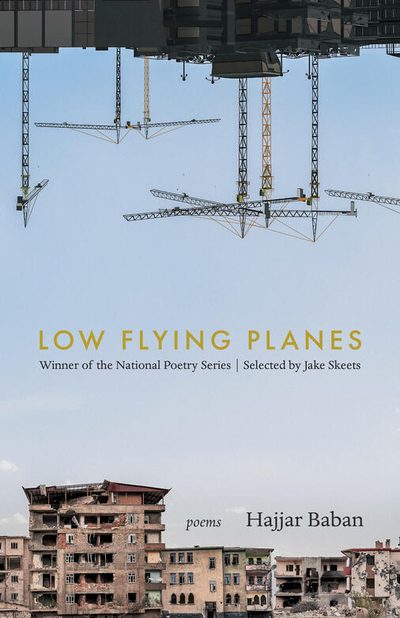
Hajjar Baban’s debut poetry collection, LOW FLYING PLANES (Milkweed Editions, 2026), asks the reader to reencounter how language can respond to silence without undoing it. Her syntax immediately resonates as a suggestion of risk, and with that risk, a fragment becomes a composition of what we might flex it into. Through this collection, Baban offers us a method of refusal: of how not to submit to the stories we have been told by holding space in her language for the stories either withheld or inaccessible. The narrative of displacement, the being kept from, the inheritance of longing for a country that does not exist on given maps, collates into an archive where Baban looks to the storks just as she looks to the planes that might drop bombs, just as she looks to her name and acknowledges it definitionally both as a word holding the momentum of fleeing and a gesture towards the potential of flying. I was so grateful to to ask her these questions about this luminous collection via a Word Doc.
*
Alexa Luborsky (AL): The poem, “The Kurdish Joke,” brings into focus a logic that tends to place certain ethnic groups into the category of “uncivilized.” It also puts forward that the “joke” is often told by friends or those proximate us, often from neighboring places. It made me think about a talk that Li-Young Lee gave at the San Francisco Public Library wherein he asks if the word, as a civilizing principle, the logos, or the dynamism of opposites, and the basis for all of what he calls “manifest reality,” if it can be disentangled from violence? He asks if “all culture is maintained by murder, pillage, colonization…or is it when we lose touch with the word, that this [violence] is what happens?”
I was thinking a lot about that in your work in general and on, I guess what it means to be forsaken, which means, etymologically, “to refuse.” There are many refusals in this collection. Or, as I’ll ask in a later question, things you “think away” from. The refusal is one of the primary ways it makes meaning for me though, because once the speaker admits that they are forsaken, or that they have been deemed as forsaken by the ways that outsiders, colonizers, view the Kurdish people (evident I think in the poem “there’s no Kurdish translation or origin of the phrase ‘no friends but the mountains’”), the power to refuse becomes meaningful, or perhaps, allows for meaning to be made less so in opposition to the civilizing principle of colonial language, and instead to make language a form of organizing the violence on the speaker’s terms.
I wouldn’t say that this book is about the political situation of the Kurdish people directly, but more so about the ways that imperialism and genocide have made a father silent and a daughter unable to sleep by a window. It refers to massacres and bombs to be sure, but importantly it refuses to direct this as the only kind of violence that happens in the wake of atrocity and displacement. In “The Mystery” for example, you write: “Because of my life’s refusal / to be categorized by a bomb.”
I see this collection as manifesting silence as both a condition of and a location that maybe could refuse the organizing principle of violence inherent to language. The father’s silence for example is not, to me, the same kind of active refusal that builds silence in the collection. This is how I see the rocks, how they work toward a sense of embodied, I don’t know, weighted-ness or just physicality that I think in a lot of your poems you don’t kind of announce otherwise. That the collection doesn’t directly identify where or how the body is experiencing silence except maybe via these rocks.
Could you talk to me about what this brings up for you, in particular if you could to speak to what you wanted language or silence to house (and not house), and why you chose to write a book in response or in relation to a father’s silence (if that is what you do indeed see this collection responding to)?
Hajjar Baban (HB): I appreciate both your saying/reading of the book not explicitly being about the political situation of the Kurds and also viewing the rocks as a weighted-ness not seen elsewhere in the poems. If it had been a project attempting to tackle the former, I personally don’t know what use poetry would be in that, or me as its speaker, and I certainly don’t think my gaps would be excusable. But I also don’t always know if I believe that it’s imperialism & genocide that have made a father be silent alone, and that’s where the “organizing” of violence that you speak of, or, rather note, very sharply, comes in. I have less language for that uncertainty and have searched for ways to classify/qualify that lack. The things underneath “The Mystery” or certain poems like it in the book I feel I might be writing towards something beyond LOW FLYING PLANES. Meaning, before knowing what a question might bring, feeling the lack of confidence, connection, deservedness to ask. I absolutely agree about your reading of the rocks, so many readers have immediately been drawn to them as an entry point into understanding the work. I don’t think that kind of embodied sense is noted elsewhere, either. It’s very hard. I relate to that a lot. They can be quiet and hard.
AL: The title of your poem, “Mist Miserable to Stone,” reminded me a lot of a poem by Armenian writer Vahan Tekeyan, titled “The Country of Dust.” I was gifted this poem by a friend, who showed me it in translation by Diana Der Hovanessian. The last stanza is as follows:
Any shock can erase you forever and no eye
will even blink. Yours alone the concern. But hope
rises like the sun. Accumulate. Dust consolidates into stone.
I think Tekeyan means to bring dust into a way we accumulate into our histories, a way to exist because of the history borne in the material reality of its thingness, and because of all the dust, all the dust that “consolidates into stone” which is our country, which is our people. But this poem, which at first I read as “Mist Miserable to Stone,” before I saw the invitation to read from right to left, became quickly then “Stone to Miserable Mist.” And so, if I read the title from right to left, then this is an activation of an image that brings stone to mist.
This poem is so incredible and honestly, bewildering, to me. Not only does it manifest a challenge in a way to the expectation of an English-speaking reader, not only does it feel tectonic, geological, to read into, or to learn, to read into another margin, or for me, remind me of watching my father reading in Hebrew beside me while I struggled to reach him from another transliterated direction at a seder; it felt like I kept reaching towards a way out of my own tendency towards a particular organization, towards my father or his father I never met or his perhaps even . . .
Of course, though, this form, in this collection, is speaking, I think, to your own tectonic, quaking experiences between languages, in your case between Arabic, Kurdish, Farsi, and Dari, all languages written from right to left, reaching towards yourself, that is, as a poet writing in English, but, who bears the mark of someone whose language is risen from all of these languages via access from home or school, or kept from, made inaccessible, particularly I mean in the case of Kurdish, by the father of the speaker in this collection.
This felt like a formal integration that wasn’t too far off from a lot of the ways you are, I guess the proper term being, “inverting” syntax (though I’d rather say flexing syntax for your work) within this collection to loop back, to break, to ask, I think, how to not make palatable by making visible or making audible or “learning to hear it properly” this earth or the terrain of the poem wherein you write was “split” by God from “[your] people.” And then offer an ending to this poem where you write about a nationalism that “captured minds / from crevices taken to sun.”
If stones are a kind of history, are a representation, I’d read, in your work, of the location of silence, of where one can dwell and choose to be illegible alongside other things that might make it whole. Is your own tendency towards the fragment what you’d call a way that you can accumulate, but not consolidate, all this “Stone to Miserable Mist”? Does choosing fragmentation, in the wake of being split from the earth violently, formulate a way of “learn[ing] to hear [yourself] properly”? Or, more broadly if you like, do the formal choices in your book feel like further shifts into the geological earthquake of violent, forced displacement, act as a refusal in some ways to consolidate? To refuse maybe to hear yourself as something without giving up control to the reader? How do you, or could you even, as you wrote this, hear yourself “properly”? And, I guess, is that even the aim?
HB: Thank you for sharing and introducing me to Tekeyan. “Yours alone the concern.” Wow. I love hearing/reading or seeing into the image of the dust into stone. You know, I don’t normally think of “hope” but that’s a really beautiful, upright sentiment. Both the accumulating and the consolidating. There’s a lot happening off the page, or between lines, in my poem you mention here. So it’s really something that you bring fragmentation and also the line about hearing oneself properly to your question/our conversation. I certainly wanted to begin with the violence that I believe is inarguable, but denied/questioned nonetheless. And, I’m not sure if this relates to the refusal “without giving up control to the reader,” but there’s also another refusal happening, much quieter/smaller against what’s seen as acts of genocide, in claiming nation. In a recent interview with David Naimon, the poet Marwa Helal (whose form I was writing in for “Stone to Miserable Mist”) asked about the conversation happening between Arabic and Kurdish in the work. After the podcast aired, I personally thanked her for that question and noted how much more I could have said, about the ways Kurdish has also been used as a dominating force, too. She wisely said, “That’s why we have other books. And more conversations.” I think the physicality into illegibility is first a nod to tragedy and “suffocation” that Bekas writes in response to Halabja. Next, it is more broadly the experience of Kurdishness, as this thing that can and has been mythologized, discredited, punished. There is also, certainly, what you say of my impulse toward fragmentation as a way toward clearer speech. But finally, and for those “more conversations, books,” there is the fact that any nation-making and declaring comes with a new/changing relationship to violence, in the pursuit of power, despite the real need/ache for safety. And I don’t know how that will look for or even be in my future works. But I do know that lives in the air of what I don’t know as much as the rest.
AL: I’d love to ask you about the epigraph that opens the entire collection: “I would not think to touch the sky with two arms” —Sappho. I love thinking about this as a way, not of motioning towards a lack of touching the sky with two arms, but pointing towards the act of thought as what keeps this from actualization. This book is filled with these kind of openings for me. Openings that may be erasures, but things that don’t negate the possibility for something to be there but point to something lost. Even at the level of the fragment, you allow the lacks within language or perhaps between the languages that you had and did not have access to manifest themselves in breakage within these poems at the level of inverting clauses or imbuing them with enjambments that multiply the meanings that are possible in the hesitation. In these ways, the collection doesn’t tend to think in opposition to any given thing. Your work feels like an activity of thinking away from something. You mentioned in your interview with David Naimon that your poem “Of His Names We Remember” was a way for you to “think away from God for a moment and think back to language.” I’m curious about that and also how it relates to searching. Another way I’m so drawn to touch in this collection is the lack of sound for the father but the unwanted touch. In “Unconventional Warfare” you write:
I observed
horror and didn’t say my father’s
touch
And, in “Ghazal Saying My Father’s Name Aloud”: “I search / for something without wanting touch.” Search becomes perhaps a way to think away from touch, into wanting something else. That the searching for an identity (as you write in “The Mystery”) or on Quora (like in “Quora Digest Search: What Do Afghans Think of Kurds?”), becomes a way of learning what the speaker isn’t meant to: “I was never supposed to learn Kurdistan.” That the lack of touch, via landscape or memory, of the physical place, for example, requires search without wanting to fulfill that lack. I’d love to hear more about the relationship between touch, search, the epigraph or the fragment more generally, and how these relate formally in your poetics?
HB: Wow I really love how you’ve connected that book-long epigraph to this question of search. I definitely feel, too, in the Sappho fragment that the thought or lack thereof, is what drives my interest. Less so as a concrete truth in surrounding but more the restrictions that exist in front of movement, in the mind. I think, connecting to your last question, one place this goes is mist/fog. And another is the mind, as belief. It almost replaces fact and truth. As I think quietly, going into my mind, with your question, what comes up for me is self-surveillance. I think it’s the knowledge of waiting for direction/permission to live, think, be a certain way before knowing what it means to ask, or more ideally, just exist. (As I transcribe this answer from my notebook to the document, my own words come to mind, from a “LOW FLYING PLANES” poem—“I’m someone who needs to be taken care of,”) I think it’s the same fear and checking through the years, too. Something carried beyond the earliest youth of these poems. I couldn’t just touch, reach out, there’s always some thinking or rehearsing or wondering about use before all of that.
AL: This is a two-part question. Especially at the beginning of the collection, I felt a distance. I mean that in how there was a certain place that you, as the writer, wanted me to stand. That there would be a refusal of linguistic clarity or syntactic regularity, the refusal to be let in, that I was responsible for. In that responsibility, or from that distance, something happened to silence, for me, as a reader or maybe as a member of the audience. The “yous,” for example, in this collection, I didn’t read as directed towards me, per say. I felt they were mostly familial, perhaps pluralized towards the enmeshed histories that family is part of even. Early on, for example, in “Of His Names We Remember” you write: “my forever aloneness for You / my wrong-forgiving family.” Perhaps, instead of thinking about where you were putting me, though, as the audience of his book, you were, in a way, bringing into experience your own sense of silence and its relationship to refusal.
“Unconventional Warfare” is full of refusals. “Because I refuse” becomes almost like the narrative action that propels the poem forward, that the refusal to say, to admit, to reveal, to be corrected. In many ways the refusals turn less and less into controlled actions, but imposed ones. The turn of this poem to me, is when the “because” becomes freed from the negation by acknowledging the lack that is inherent to the story. The “because” becomes manifest via what it then does not have the capacity to refuse: “because it was easy to reckon with being / invisible when I’d attempt the loud noise.” I don’t read this as a voluntary or controlled refusal, but instead as one that changes the dynamic of who can act, who is the agent, and what is an inherited response. I feel closest to this speaker in that moment, like she is letting me in on her lack of control, which then is solidified when she says “because as a child when adults upset me / I’d refuse to eat refuse / to pray.” The body, one of the few things that a girl has control over, becomes at risk, via refusal. This poem feels really connected to “The Core Memory” for me, which seems to have a similar placement of the body or the self being at risk in the refusal or the questioning of what is being told to the speaker by another generation. For me that comes out especially in the lines “Being born without thought / then finding distrust in what makes one move” and “Where I live welcomed to refuse what I see.”
So the first part of this question doesn’t even get to silence yet, but I’d love to hear more about how or if you thought about audience; if you thought about your family reading this and how that influenced the ways you decided to tell this story; if you thought of this as a “Self-Portrait with Caution” wherein the only way to find a method was to tell yourself as fragment; and if you would you speak to what it was like to be the “family’s teller” and also the one without direct access to their own memories; and, lastly, the anxiety about “lying” as you’ve put it in previous interviews?
HB: First, I love that you’ve read the “yous” as mostly familial, actually the final “LOW FLYING PLANES” poem that I wrote (which appears as the first one in the book, [Tricky rattle that conversation]) was written much later than the rest of the poems, as I first began my current work-in-progress, which thinks of a plural you in “enmeshed histories” as you say. So even if that idea/use of the “you” as you note might be echoes of what’s to come, I think the attempt working towards it definitely lives in these poems. But I’m not sure, for the majority of these poems, that this use was intentional as I think of it in my recent work like “Echo.” I say this because the “you” in LOW FLYING PLANES is messy and less realized, at times the beloved, or God, but always also some idea of family, I think deep down that decision was also a refusal of being read in exactitude. Another thing, about audience, I always operated under an assumption my family would never read my work. I’ve been publishing my work for almost a decade now and I think always felt like at least in writing about my parents that because they can’t read that I needn’t worry myself too much with what it means to write “father” focused poems, or whatever. I think the refusal/“blacking out” in one of the works in LOW FLYING PLANES is less about my family’s feelings and more how I felt at the time writing in response to other writers’ expectations.
Off the page, I definitely have more thoughts of what stories aren’t mine to tell, what might take me many more years to get to, of the anxiety of lying, of safety/what it means to speak. In “Reading Celan in Dearborn, Michigan,” I make reference to my maternal grandfather, who was disappeared in Kabul, a story my mother has told me before and I find difficult to think of, imagining my mother as someone, a child, with this life ending uncertainty, the movement following shortly after forcing all this distance to the event. I mention this because unlike my father, she would like to tell me that story, and has even said on multiple occasions, that I should write a story about her/their family life/story. Writing about the violence the dead have seen/felt before thinking of how much violence is in my family at present is difficult for me. I think it’s also hard to face that the dead/disappeared is present just as much in the stories shared with me as the ones not.
Another thing, because of the book, I’ve tried for the first time to really put myself out there. I have a lot of siblings! That’s a good several sales lmaooo. But yeah my sister said how she read the book, something along the lines of, “it’s so interesting to read things from your perspective, how you saw things growing up. I feel like we were really living in survival mode.” And recently, another sister of mine came to an event I did for the book. I think, despite all the refusals in the book, I do believe she was seeing and learning about me because of the invitation in. Despite the refusal, the thinking away from, it felt bold and revealing to share eyes in the space. It’s not an answer to your question necessarily, but it probably relates back to the question/convo in the Sappho quote., I had written these poems and still felt more focused on the thinking than I did on reaching toward. So in sharing for the first time ever with my family, I am a bit humbled by what they have shared back so far.
AL: Part two is about the storks (of course!!). We’ve both acknowledged how precious these storks are to both of our peoples. The ways they migrate in, the ways they always return to those huge nests. Their bills and their clattering. In one of the “LOW FLYING PLANES” poems, you write:
I’m failing for all I’d like to forgive
you hear me? I want to help what you want to hear.
Cage in repeating, trying to still see
a green beyond the broken stone
clattering shame.
“Clattering” being the sound of the birds that the speaker is taking on in this poem, not to me as a product of shame, but as what happens when we are “trying to still see / a green beyond the broken stone” and acknowledge that it too is clattering, or echoing, with shame. I’d love to bring this into conversation with another, later, “LOW FLYING PLANES” poem, where you write:
Because my mother decided
to name me after flight I abandoned rocks
I left countries. Emerald
that could never be blue and lavender
rose. I’ve forgiven every danger
just to sleep with no stone
in my mind.
…………………………..
…………..So I could tear,
beyond imagining what above
would fly.
The speaker here, taking on their name as an invitation, in a way, to acknowledge that the action of their name being one of “flight,” this might not only invite the act of fleeing, but also of flying, and particularly, of flying despite the knowledge of the danger, of the things that dwell in the skies that would harm you, to imagine something better, just as the storks are able to do. (For folks who haven’t seen storks flying, they fly REALLY high. So high, though I’ve never thought about it before your collection, they might be or at least look to be the same altitude as a plane flying low.) In another “LOW FLYING PLANES” poem:
Language wasn’t so ceremonial anymore I forgot the storks
that forgiveness would decide my face it applied to my taught belief: beyond the mountains
not mine I couldn’t be so strong.
The storks, their flight, which the speaker has identified as a method of imagining what is beyond shame, and now too perhaps of “forgiveness.” In the poem, “Forgiveness,” where the speaker says that she couldn’t sleep in a room with a window, and the reader is left to assume, most likely, for fear of the bombs or the sound of the planes that would drop them, a mother who wants safety, to which the speaker responds:
Mother: once you’ve felt scarce inside, that heavy
hollow, there is no more rest. You can only be
willing for danger.
Finally, my favorite “LOW FLYING PLANES” poem, if you’ll allow me to quote it in full:
The plane intercepting sight of the shooting
star. I’ve questioned before—
that sentence between silence was my time,
I was convinced birds disappeared
in the green, that someone was inside listening,
my music-lacked conversation,
sounding contaminant.
[Reprinted with permission from Milkweed Editions.]
I’d love to talk about how these birds relate to silence and forgiveness for you, inside the collection but perhaps also, if you’re willing, outside of it. Storks that are “stalks of silence” (from “Bill Clattering, the Stork Speaks”) that might complete the air. Storks that offer ways into acknowledging shame and findings imaginaries for forgiveness. Perhaps, a vision of “forgiveness” understood in opposition to loneliness? Or that these are the birds that might address the precarity of forgiveness and how it cannot be, under these circumstances, something that can be given? And, forgiveness for who? Of course, not a forgiveness directed even remotely at the perpetrators of the massacres. Given the address of the “you” that I read throughout the collection, this forgiveness might be one offered between speaker and family, or speaker and what, more coherently, she lacks. Can you talk a bit more about storks, shame, and forgiveness, as you see fit?
HB: I lovelovelove that idea of forgiveness between the speaker and what she lacks. It makes most sense for me in thinking through your question, because the storks became a concrete thing, a name to a bird, sound to a bird, something our people greet and wait on and write stories about. Even in that, the lack still exists because beyond name and sound, it’s the search I return to and learn more, for example the stork that “bill clatters” is not the same stork, I believe, that your and my people know. But when I happened upon the name for storks, (this was before, or rather the natural happening upon that precedes the subsequent search) when they return from their migration, “Haji laqlaq,” it made me think of how I’d heard that name before, “laqlaq,” growing up. This is probably a more damning anecdote than anything I’ve written about my father in LOW FLYING PLANES, but he’d call a family friend that growing up. I guess I never thought to question the nickname, what about her gave stork, what it was revealing about my father’s references—that it wasn’t just a Kurdish word for bird but something specific, something real. In hearing your question, I thought of this story because it was for sure a moment of forgiveness that allowed me something to claim, even in all the shame, a recognition in the search! Because I really do love how demanding the stork is, or maybe I mean commanding, yet also representative of commitment. Idk the idea of leaving, of return? And in some cases of witness, of waiting, of not returning? And just now in checking the spelling of laqlaq, seeing that a group of storks is sometimes referred to as a “muster.” In thinking of speech and also some idea of form. (I also think the image of them interrupting the plane, in the space of both metal/electricity and sky/nature/flight was something working me off the page.) It was easy to grieve what I had and so much harder to forgive what I didn’t, so I think I used the word a lot, forgiveness, or prayed toward it, even inwardly, without thinking much of how it’d be read outside of those mentions, or even within them. (It’s why, sometimes, you might catch me still saying I don’t know what forgiveness means.)