
Interview// “Black Life as Ecological Flux”: A Conversation with MaKshya Tolbert
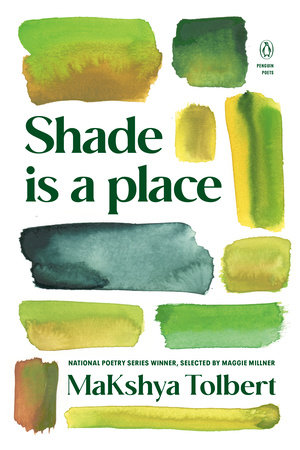
I’ve received many kinds of invitations towards a shared attention from MaKshya Tolbert. Their collection, Shade is a place (Penguin Random House, 2025), was one such invitation. Tolbert’s collection and her practice of shade walking makes a place for us to attend to ourselves and each other a little more carefully in the wake of slavery, ecological collapse, anti-environmental redlining, and the extractive systems of empire. I was so grateful for the opportunity to invite them to attend to some questions I had about their Black queer ecosocial practice of walking, wandering, writing. This interview was asynchronously conducted via a Google Doc.
*
Alexa Luborsky (AL): I’d love to start by talking about the title. This is a question in a few parts! I’d love to think first about shade, then shade as a “place.”
Val Plumwood designates “shadow places” as the many unseen or underseen terrains “that provide our material and ecological support” and which “are likely to elude our knowledge and responsibility.” She’s thinking globally and in the context of a global market, wherein there is a lack of responsibility for these “shadow places” that bear the brunt of the ecological burden. She calls for “community networking arrangements” towards reintegrating these spaces as locations that people can take responsibility for via a connection to “belonging” to them.
So, I’d love to hear you talk about this particular place, Charlottesville’s Downtown Mall, a place that is in many cases unseen as a project of white supremacy wherein a vibrant Black community, Vinegar Hill, was raised in the name of “urban renewal” initiatives, one among many similar projects from the 1940s to the 80s. The willow oaks themselves are identified by the speaker many times as one of these underseen terrains. In “Tree Walk with Worry” you write: “Beholden to the accidental violence / of what we don’t notice.” The speaker also, in putting attention on these sick trees, is able to attend to their own sickness. In the opening poem of the collection, you write “Can I speak about thinning?” The unseen is not only the literal spaces that provide ecological support that are being felled, but a speaker is trying to find a way to talk about their body as one among the trees that is hurting itself as a result of what is being underseen by the people surrounding them, which they themself don’t exclude from that lack of attention; the “we” important to the “don’t notice.”
Many times the trees are choked, burnt, harmed, because they are beyond our attention. Val Plumwood asks for connection, which is also what I hear the speaker asking for, but in a more embodied way. By that I mean, by asking their own body to be attended to as they motion to the trees, inviting the audience to notice: “Here is this tour / of my body // Will you walk with me?” and to me, it seems like shade might offer a place for that performance of attention, literally I mean underneath the canopy, to practice how to teach the self and others to attend. In the final poem, “Satisfiable,” you write, “I take to my body.” I’m wondering, what do you hear your speaker asking for in that line (with its caesura and all!)? Or, what I mean is, what shape do you imagine the speaker, or the trees, or the community in the shade of either, looks like within this practice of “noticing”? What place does “shade” have and how, or where (in poetry or life), do we take responsibility for it? And, if you want, how or what are you asking for when you ask for shade to be thought of as a place?
MaKshya Tolbert (MT): Part of what drew me to what the city calls “public trees” was the capacity to both be on the receiving and stewarding end of material and ecological relief and support, in terms of arboreal shade. In some ways, I was seeking out some of the relief Plumwood writes toward in her thinking about “shadow places” and their qualities of provisioning material and ecological support—amid our failure to care for them. My desire toward Shade is a place and its poems came from a desperate longing for a kind of support or relief that was ephemeral, uncertain, but supportive nonetheless—even if only for a moment.
I have always been drawn to chattel slavery as a global failure of care and a lack of responsibility, alongside being an ecological, relational, and really crisis of all kinds. So I’m interested in Plumwood’s intrigue when it comes to a kind of global responsibility toward shadow places. I was curious about how to practice responsibility … and about my own capacity for care in the wake of slavery, losing my family’s only home, and the serial losses in the pore spaces between.
Charlottesville’s Downtown Mall gives me a setting, a situation (thinking of a favorite poet of mine, Christopher Gilbert, who writes, “We are our situations”) through which I can practice acknowledging these entanglements, these failures of care and experiments with connection in such regulated and contested space. Doing so is both my desire and also my condition? The Mall gave me a place, pace, and set of inquiries to embody what Kimberly Ruffin theorizes in her work Black on Earth, exploring Black writers, thinkers, community leaders charting out a sense of language—and aliveness—in the irreducible and entangled condition that is the ecological burden and beauty of being Black on earth.
Shade offers a place for a choreography and performance of attention. I do think almost everything offers that, if/as one’s inner environment is open enough. So I wonder if openness is the shape that the books’ speaker, trees, and wider community of practice attempt to take on in service of noticing. Outstretchedness comes to mind, width comes to mind: and through that openness, a fragile capacity for responsibility, intimacy, and connection emerges. Sometimes.
My speaker is constantly asking (begging?) for ways to participate in the entanglement of being—they’ll take the loneliness if it opens up some of the light. They’ll be at fault if they can also practice graciousness. In “Satisfiable,” the speaker you’re asking about is asking for or maybe even just taking the space (for themselves) that they sought out for much of the book. They’re acknowledging one thing the posture of openness has done or done part of, which is redirect the speaker back to/ward a sense of responsibility for their own physical body and inner environment. What was exteroceptive (listening out) becomes interoceptive (listening in). So like you pointed toward, motioning towards trees circles back to the place (or mind) where the motion came from.
In terms of what I want when I “ask” for shade to be thought of as a place … I’m not asking, maybe? Something more insistent is happening here, something more fraught, too. It’s an invitation into what comes above the line of awareness as my attention (or anyone’s) widens enough to see the way shade is always already propertied, racialized, and the site of false refuge as much as true. Rather than asking anything, I am saying what I see and letting it break my heart. And opening myself up to whatever happens from there, in my experience or someone else’s.
AL: Still keeping with the title, as a part two, I’d also love to hear you talk about the word “place” more expansively and what formal decisions you made in these poems in service of it. “Place,” which is often a form of relocating the word “landscape” in postcolonial thought. You gesture towards this when you write “Landscapes are conditions set out along open ground” in your second haibun sequence “Shade walk: ‘a life in rehearsal’ (east-west).” And, when you’ve spoken about this project, you’ve described it as a way of seeking “a Black sense of place.” Within this conception of “place,” I’d love to hear about the focus on the Halprin “living rooms” and their relationship to life on the mall and to your own poetics of spacing and p(l)acing.
The propertying of “place” is part of the genocidal imaginary. Thinking about the notion of “lebensraum” or “living space,” is an idea that not only places a demand of place-as-living-space, but also suggests a propertied relationship in that it suggests whose life is worthy of living in that space. The Nazis used this idea as justification to expel queer, Jewish, Roma, and Sinti peoples, in addition to political prisoners and other prisoners of varying non-German nationalities, from this “living space” that had a designated “owner.” Similar to this redlining project itself that brought us these “living rooms.” Of course, both of these are inspired, at least in part, by the plantation system, wherein, as Jill H. Casid notes, “it is not merely that the paysage could be enlisted to represent empire, but that paysage, the political, economic, and aesthetic ordering of the pays, made of empire a sweet and harmonious alibi, painted and planted, that is, empire as a fabricated fiction of cultivation and civilization.” The particularities of the measurement and conception behind who is invited to live on the mall, is intrinsic to Halperin’s design of and alibi of the white supremacist landscaping of Vinegar Hill. You point to this when you write “Let’s loiter the rest of our lives” in the poem “Shade is a place: relief is my form.”
I’m curious about what it was like, trying to find living room on the Mall, in your poetic practice and your walking practice, while in a place that was hostile to both the willow oaks that are the focal point of the speaker’s attention alongside what is happening to their own thinning body, and how did you go about thinking and rethinking that relationship to this place, and even, to life, or the living space of your body? And, how did you decide, formally, to engage with that in terms of your poetic pacing? Much of your place-making is also pace-making, or scoring, of where we, speaker and tour-audience, but also speaker and book-audience, are together on the mall.
I also see this in relation to your use of caesura to mark a lack of center that feels like it wants to prioritize openness while speaking about bodies that are thinning. Of course, a stanza is Italian for room and a standing place in Latin. So, with all that: how do you envision these poems, formally, p(l)ace-making our tour of the mall? And, if you want, perhaps what kind of place was made available to you with the haibun, a form that demands you to think in prose, that might not have been available to you in a lineated form? Or, to put all of these many questions into one, would you talk about “shade” as a particular “place” and how do you see (y)our relationship to it across this collection, paginally, and perhaps outside of the book entirely?
MT: I can feel that we share heartbreak about living and breathing in the aftermath of our ongoing and violent relationships to each other. You have always been a person who I can bring that kind of sorrow to and it’s more generative than you know for my life and work! It means a lot to me that you engage with the deeper trauma and interiority embedded into Shade is a place’s attention, social practice, and poetics. And into my life.
I want to start by sharing that my insistence and trial-and-error practices what Black feminist geographer Katherine McKittrick calls a “Black sense of place,” and sets out in the aftermath of and amid ongoing and constant ecological violence and violences of all kinds. I was recently reminded by Malkia Devich-Cyril that “loss is a shared experience,” which I’m sharing because I think your questions get at the distances between us all and the kind of unprocessed grief and fear that the State incites, feeds off of, and prays will live on in perpetuity. A friend of mine was generous enough to introduce me recently to the Jewish Labor Bund and their insistence on ‘doikayt,’ or “hereness.” And it felt kindred with a Black sense of place and the desire not for property but for each other. I feel so beholden to that.
When McKittrick theorizes a Black sense of place, she’s offering a method for shoring up a life against the “knotted diasporic tenets of coloniality, dehumanization, and resistance . . . a sense of place wherein the violence of displacement and bondage, produced within a plantation economy, extends and is given a geographic future . . . A Black sense of place is therefore tied to fluctuating geographic and historical contexts,” (McKittrick, “On plantations, prisons, and a Black sense of place”). The heartbreak about the aftermath of ecological and racial violence is where my work starts: from a position or ecofeminist location some nearer to “the bottom” in many senses of the word. “Black livingness” rubbing up against attempts to erase Black livingness.
I felt a longing for and responsibility to chart out said “Black sense of place,” needing the choreography of Black feminist, geographical thought and practice through the aftermath of the kind of imperialism and state-sanctioned violence and rupturing of language that often does proxy as a “sense of place.” I see it in the “sense of place” of Virginia’s slave tradition as much as in Zionism and many other state-sanctioned insistences of place. All this in the aftermath of Black enslaved laborers being forced to decimate and deforest the forest and being forced to make real slaveholders’ sense of place or a kind of urban residential sense of place in which our homes and dwelling in kinship networks are completely riddled with losses so that white families and individuals can have the sense of place you so aptly summarized above.
Because Black life cycles through both constant fragmentation and displacement and also constantly insisting on everyday living, on a porous sense of place … I sought out a “Black sense of place” as a kind of adaptation to where one is, ecologically, poetically, and otherwise … I needed a process to yield to and live through the flux. Flux being the closest word I have right now to touch one’s capacity for everyday life and movement amid cycling conditions of time and place. Suddenly I’m thinking about Amiri Baraka’s language of the “The Changing Same” and all the ways we have to describe what it is to loop a life together amid conditions of time, place, and extraction. Your question lends language to my own question; is Blackness flux?
Shade is a place doesn’t choose so much to be a part of the entanglement and violence you’re naming or I’m naming, as it acknowledges and yields to reality and tries to chart out a pace from there for breath for relief and for a porous intimacy in the middle of things. And when I say in the middle of things, I mean to be in the middle of everything breaking your heart and kinship networks and my heart and kinship networks.
In the wake of violence and a love of property over most else, Shade is a place attempts everyday living and breathing in an environment where power, property, and management seem to me different names for what matters most to the City, in the formal sense. The poems where I’m engaging with my own capacity for violence and regulation, those are all inquiries that have come up in the aftermath of studying chattel slavery. I try accounting for what it means to be intimately and psychically forced into a project of placemaking, into a kind of forced building of America and white supremacy and separation. So because there is so little refuge or “place” for Black folks, from the kind of half-life or shelf life of what place was and is and continues to be, I take this Afro-pessimistic-ish stance and its recognition of my condition and my responsibility. From there I practice a life unfolding that can be as caring and attentive as possible, but participates nonetheless in the entangled projects of violence and care. Everyone is there! Shade is a place is also a place for mourning the relationships between us.
AL: I have two questions on rambling, but want to ask them very differently. First, and going a bit deeper into “scoring” and all its iterations: there are these visual ruptures, or scores, and then there is the underlying “score” of the haibun that manages us along the second section (and I use that word “manage” carefully, literally I mean with lots of care, but chargedly). I’m thinking of Fred Moten’s In the Break where he talks about ritual as gestural and instrumental. And I’m thinking along that line of your shade walks, as both ritual, but one that allows the breakage from what that supposed ritual is, is inherent to the jester/speaker as gesture of clowning the “tourism” of the mall and how, outside of this collection, I know that you were interested in a more porous interpretation of what a tour ritualizes. By that I mean that you were interested in breaking the sense of the tour as a narrative, linear exercise where folks walked with you along a prescribed route for a prescribed amount of time. This too, is related to Moten’s ring-like concept of the “annulus” that invokes a looping temporality that allows for occasional rupture. On this ritual/non-ritual lyrical time, he notes that there is “a temporal contradiction in the opposition of ritual and nonritual . . . the traumatic/celebratory and obsessional rhythmic breakage of the everyday . . . that transforms rhythm into a double determination: of position or movement, on the one hand, and syntagmic order on the other.” I’d love to hear more about humor as rupture, and how that risking of ritual might inform the way you’re thinking about both the gesture of the haibun-as-tour and the literal ecological-attention-as-touring that you did as you walked, rewalked, looped the mall to “come back” to a body in relationship with the willows and their felling.
And, you use the word “ramble” to describe your walk. A ramble, which is typically defined as a leisurely wandering, but can also refer to a casual gathering of musicians. The title to the second haibun section, “Shade Walk: ‘a life in rehearsal’” is a reference to Ruth Wilson Gilmore’s description of abolition as “life in rehearsal” and a festival called “Rehearsing the Future.” In the article you shared with me about this festival and its initiatives, Panthea Lee (李佩珊) writes: “What does it mean to live in a world organized around greed and violence that asks us to adjust ourselves to better endure its harms?” These adjustments, these formal decisions you are making on the page and off, feel like ways you are asking this question of yourself, your speaker, and your audience(s). A way to wander, ramble, practice.
I know we’ve talked about your not being tied necessarily to the word “lyric” to describe your poetics, but I’m wondering if you can talk a bit about the invitation for rupture of rhythm, for throwing shade, for nonritual, for position as a location from which to disrupt an ordering? Be it time or something else?
MT: You’re right that I was eager to trouble the tour’s linearity, and also that there were some earnest desires to participate in a kind of messy, recreational experience. I guess I’m trying to say that anything I ‘break’ I also try to care for at the same time. Sometimes I’m drawn to the shade walk as a kind of ritual, which reminds me of my own insecurity. I have always wondered whether I was competent at the sacred … but I’m thinking of choreographer Twyla Twarp who once said that a ritual is something you do because it is necessary. The humor where it’s found in the book was initially accidental: I was too afraid to be funny, afraid of levity. I wanted to get underneath the laughter, find where it hurt instead. But I found myself in a humorous and then suddenly earnest inquiry for relational and ecological practice. And admitting my fears broke open so much of that practice.
I wonder if the shade walks offered a way to practice ritual (or what’s necessary) alongside what’s actually happening. I raised the stakes of the poem-tour, infusing the trees’ needs and all our own needs into any capacity for ecological and atmospheric relief our walks could open up. I recognized in myself and my work a responsibility or something that compelled me to invite these part-open and part-closed scores that began to loop place, property, and persons together. And to also begin to loop our breath back. In that way, there’s an aspiration to engage with Shade is a place or shade as phenomena as a kind of “annulus,” or method for the annulus’ circularity/looping temporality. I needed something episodic, cyclic, breath-taking and -making, and the shade walks offered a series of inquiries—how much would you pay for relief?—and those lent themselves to gestures and experiences that brought me closer to the body of the mall, my own body, and the forest-body. I feel the same loops these days as I walk Jefferson’s circular road traces at Monticello. Up there, I’m looping through both spring and the roundabouts, listening for myself and everything else. Building an even more fragile practice of Black livingness that loops through slavery’s aftermath in even more direct fashion—there’s the circularity and the looping again. This is partly what led me last year to bend that ash wood mobius strip into being, as a sculptural and self-inquiring experiment in what shape or pace the breath work of living could take place, amid being given over to so much management.
In the circle, no choice but life, for me … and so I set out toward a poetics that takes on some of the ambient conditions of time and place. For that reason, I believe the lyric sense is less “mine” as it is just being part of the amongness of things. Something I pick up on, and that sometimes fits and sometimes doesn’t. I think I have opened up about the word “lyric” a bit since we last talked … and find that it entangles itself in poems like “Shade is a place: missing a center” where the space caesura makes can mean breath just as much as serial loss and the flux is less like an ‘event’ and more like a day.
One more thing. Shade walking was also this on-and-off-again experiment with leisure, with any capacity for recreation in the midst of things. A faculty advisor noted once that my walking seemed to exceed the flaneur’s ‘stakes,’ seemed to want something more. I didn’t and still don’t quite know what to say about that, except that up to that point, I’d rebuked the notion that ease was ‘for me.’ My traumatized fixation on being of service or some maladjusted motivational life kept coming along, too. I’m okay with the tension and continue trying to find the words for wanting to be both wayward and reparative all at once.
AL: Second question on “rambling”: In “Shade Walk: a haibun (east-west)” I’m drawn so much to the verbs you use for how you are making your way, and how the form is pacing us for multiplicity. I mean that in the sense of the haibun as both return, formally, to haiku, and a way to at once both recompose and inform, the preceding prose passages that we take along this walk from east to west. On a more micro-level, the haiku itself has an embedded technology for meandering. The third line is meant in some ways to disrupt or renegotiate the pattern established by the first two.
The technique of the haiku that closes each haibun feels like a technology you establish for how to honor Halperin’s directive of his “score”: “not one experience but a series of experiences.” I use technology and technique, because I’m thinking about the transition you make from “Hope is a discipline” to “maybe a technique” to close this haibun. I am thinking of the switch etymologically, from “a training” to “an art or skill.” Halprin, you write, “saw the Downtown Mall as neither mall nor place… // but as a continuous meandering.” You also later note in this haibun that, part of these living rooms, were 150 moveable chairs. Then, “Shade fades, Halprin’s chairs sit nailed in my mind.” And, towards the end, “When Lawrence Halprin & Associates drew a score for the Downtown Mall, they walked as if movement was their discipline. As if meandering were construction’s method.”
That word, “discipline,” makes me tense, especially when I read it in conversation with: “As if meandering were construction’s method.” I read it in relation to the replicated chairs that are nailed down to the ground as an affirmation of ownership and “constructed” immobility. All that feels in opposition to this “rambling” that the speaker calls their walk, as well as their directive: “I said I want to be good: at being under construction, at the ramble.”
MT: I’m ecstatic about how sensitive you are to the tensions in the book. I went to face them on purpose, because I got aware of (always already) being a part of everything, whether I was aware of it or not. I can’t speak to your tenseness but can say regarding mine that ‘discipline’ made me tense too; so I went closer toward it. For better or worse. I threw myself—propertyless, unable to drive, mentally unwell, and amid intimate serial losses—into my own internal and socialized relationship to discipline, to work, to discernment. I had to come to terms in this project with my very real and twisted participation in the “project” of ownership, of management, of being “good,” even. The moments of regulation on the mall, even aspects of guiding a “tour”—none of it claims to be free of participation because it could never be. I wanted to insist on the courage and foolishness to publicize what it’s like to work both toward and against being, toward and against care, at the same time. Sitting under the heat lamps one evening, lamenting their presence the next. You’re pointing out one place where I’m practicing seeking solo and shared experiences in space and with others to process my own failures of care before and as I begin to address those of each other and of the state …
… and it looks like looking for direction and shape at the haibun’s pace. I do feel drawn toward Halprin’s insistence on the Mall as an invitation and “score” for “not one experience but a series of experiences,” and that I wonder if what he called a series of experiences is also a way to talk about fluctuation, precarity, changing conditions that eerily don’t quite seem to change. I felt the Mall’s material culture and the Basho-style haibun’s shared a capacity once woven together to hold some of the fluctuation of my inner environment and the Mall’s environment. Renee Gladman and T.S. Eliot must have lived through losses near the ones I or we are in the middle of because I found in their work so much comfort and breath when trying to gauge whether I was brave enough to face my own inquiries. I am also drawn to your haiku-curiosity. Haiku offered such a crucial shape and tradition for ecological flux at its most devastating and an aspiration to embrace the flux of things, at its most humbling. I’m still so struck by the third line of a haiku’s capacity to disrupt the pattern set forth by the first two lines. Which means, maybe, having some understanding, even if fluctuating, of the patterns in front of you. It makes me think about the willow oaks on the Mall and their stresses: and then finding that open up into more generative attention that interrupts the established patterns of duress—for the oaks and the speaker alike.
Someone I’m not close to anymore said once about a talk I gave on Anne Spencer, after Shade is a place had already been picked up, that I take a long time to get there but eventually I wrap things up beautifully. That stuck with me in a sweet way. And you see the part of what he said that is intentional, I think—that I ramble on purpose despite its frequent foolishness. I’m drawn to the ramble’s intentional waywardness, despite also being a unit of speech and measurement and for some, distance. Not so surprising given my girlhood—I had quiet and then stuttering phases and they scared me and the people around me—I think. Rambling reminds me of what I sounded like before I was forced or forced myself to sound different. I’m thinking about growing up with a stutter others made fun of. I’m thinking about the work of recovery I’m currently engaged in. All these opportunities to listen inward for what’s changing or was always there. I felt the ramble could hold as through the porousness of a ‘self.’ It feels like seeking out in myself what Howard Thurman called “the sound of the genuine.” And what Thurman’s mentee, Dr. King, knew to take on; Dr. King has given me a language around “creative maladjustment” which Shade is a place tries to take on as practice.
Finally, Sarah Jane Cervenak’s Wandering: Philosophical Performances of Racial and Sexual Freedom feels like a seminal text for my wandering heart, tongue(?), and attention. And after reading that book, and hearing your question, I’m remembering that the Old Norse loves me, at least a little. By that I mean that I revisited the etymology of ‘haunt’ and it seems right to me as we’re trading thoughts that part of the ramble is indeed entangled with a word that gestures at the work of what one “busies oneself with” to “go or bring home.”
I’ll end on living room. In many ways, I start with Halprin’s sense of living room and then my lived experience and engagement with Black women’s ecopoetics and practice pulls me even closer toward the ground, into my innerness and my practice. It’s an intense, intimate layering that doesn’t even make sense to me some days. Halprin’s sense of the Mall as having a series of “outdoor living rooms” invited me into an engagement not only with the granite, slate, brick, and material culture of the Mall, and Halprin’s desire for a ‘place’ where some members of the Charlottesville community could dwell; but also with Halprin’s larger participation in urban renewal and settlement projects in the United States and Israel. He’s a complicated figure for me, given his engagement with displacement projects in two countries at once. But I live for that kind of complication and chose to come to a highly regulated place with inquiries about breath in an overregulated time. Here is a nice time to balance Halprin’s inspiration with June Jordan’s, who had her own architectural vision and practice. I thought and wrote alongside her poem, “Moving Toward Home,” where she writes:
“I need to talk about living room.”
Jordan has this insistence on a kind of dwelling and spaciousness that one has access to amid regulated and carceral conditions. I needed to take that livingness both inward and outward. How do you become a channel for living? I was looking for poetic forms that could hold searching for something akin to relief or space. I needed locomotive poetic forms, I now know, which could hold both a kind of center or innerness (and dwelling) but also a capacity for movement, however wayward and however fragile. A form that could hold both an intimate process and social practice. Basho’s life and Black feminist geography and practice reflected some of that shape back to me.
AL: I want to bring the thoughts on transition and quiet and coming back that are inherent in this collection into conversation with the keynote speech by Ruth Wilson Gilmore that was quoted earlier, where she says, “Abolition is presence, which means abolition is life in rehearsal.” And also to what you write in “Again”: “Practice not hope but noticing.” At your book launch in Charlottesville, you remarked: “One thing I know I love about this book and this project and this community is that choosing to mainly see problems can only work for so long. I’m so glad I pushed that method to see how far I could take it, so that it could collapse into practice, poetry, and trying toward awe.” You note in “Shade walk: ‘a life in rehearsal’ (east-west)” that what we call a group of turkey vultures depends on what they are doing, after describing the ways that the shade-walkers and the speaker are all learning how to be close to the trees, but not necessarily each other. And yet, there are many acknowledgements of attempts made on all sides. And, you write, “The more we walk, the less my chest hurts.” In the final poem, “Satisfiable,” you write: “I shed down to quiet a quality of standing still.” In Note 2, “I went looking for cues or clues or quiet for a westerly way back to myself.” Are hope, awe, noticing, transition, and quiet, distinct but in the same way that what we call a group of turkey vultures is distinguished by what they are doing? By that I mean, are they all, perhaps, sharing a physical, material body, but doing different things in service of it, thereby changing what we call it? If not, how would you describe the relationships between them?
MT: I chose my poison (ecosocial precarity) both carefully and carelessly. I was really excited for years to practice life and poetry with oddly high stakes and oddly wellbeing. I wonder if that’s why the book opens up seeking relief through self-apprenticing to shade trees, and ends trying to share the shade and some wonder. I failed to ‘save trees’ and am grateful that the attention shifted toward rescuing some capacity for an inner and shared life, instead.
I would get punched if I tried to tell anyone what hope, awe, noticing, transition, or quiet are so I will first say that I am bewildered by what we mean when we speak these things into being yet humbled and comforted by what happens when hope, for example, looks like embodied practice. Hope for me means nothing (caring) in my mind. That said, what began as ‘hope’ in service of a more vigorous sense of place translated into finding a way to move my limbs along a zigzagging corridor of trees, bricks, and people. And in that constellation I found that hope had at least some use. What I’m trying to say is that even what these specific words mean to me is as much in flux as anything (and everything) else. I certainly don’t feel they stand in at all for each other but I do think sharing a body as you said offers some shape or sense (at least for today) to their nearness to each other. When hope was a disappointment, noticing gave me something to do with myself. At many points, noticing gave way to awe. Quietude was akin to an ongoing condition of awe. I’m trying to say that the flux lends itself to fragility as much as to a sense of things and being bewildered by what I or anyone meant by ‘awe’ or ‘hope’ gave me so much to do; before I knew it, I had a book. I wonder if what we call things is distinguished in some ways by what they’re doing but in stronger ways by our attention, or our own motivational forces. When I began trying to build an intimacy with vultures, as they hovered high above shade trees, I wanted to belong and watching them move and seeing the words change gave me a sense of movement and language, too. And amid the loneliness, I wanted to hurt less. Belong more.
Now, I look up and laugh to myself that I was so drawn to arbitrating their movements, or my own. I share this because I increasingly wonder if my relationship to language up to this point (and maybe also my heart) was somewhat stifled by constantly trying to arbitrate or assess what was happening—from where I stood. And I’ve noticed that Shade is a place brought me close enough to trees to at least sense their basic nature—and mine—which continued to exceed the words and laugh at my effort. Shade is a place is a large experiment in how to love each other or ourselves or the earth as our relationships to each other or ourselves or the earth fluctuate in the most loving and loveless directions. I am not sure what method other than ‘practice’ as embodied living allows me to do this every day. This is my segue into what you’re asking me to reflect on about Gilmore and the decades of work she’s done and shared so generously about abolition, practicing freedom, and being with each other. I felt I could heed and take on the integrity of Gilmore’s thinking by ‘rehearsing’ more open ways of attending to my inner environment and our shared material environments. Rehearsal opened up a Black queer ecosocial space to repeatedly ‘account’ for life unfolding, and a choreography for the otherwise unfolding simultaneously above our head.
Thank you for asking me these dear and also fraught questions about bearing a heart, an appetite, a kinship network, and beyond—in the middle of things.
AL: At last, I have a short question for you! I was once asked by a shared advisor of ours, who was helping me with ending my own manuscript: if you could leave your collection with a body, what shape would you be?
MT: Beautiful. Thank you so much, Alexa, for how you incite curiosity in me. Here comes MaKshya ‘tendril’ Tolbert! “Their irritability is beautiful,” Darwin wrote of tendrils to friend-collaborator Asa Gray while working on his 1880 project, The Power of Movement in Plants. He loved their immense sensitivity (their responsiveness to stimuli) and how little it took for tendrils to respond to light, gravity, and touch itself—I need you to look up thigmatropism! And I feel through tendrils my own sensitivity looping back toward me. Tendrils reflect my own choreography of being to me, through their own. They show me my shape when I come out of hiding, which is locomotive, alive, insistent on living. It’s sort of funny to only be understanding this on the other side of these shade walks, where a fraught and porous sense of self tries to come through. Another way to say shape, perhaps? This is getting close to trees and building an intimacy with them, and so much else … so yes! If the work and the earth could work on me such that I could be that open, that sensitive, that vigorous-through-touch, that okayness with how my rampant life unfolds. …
Darwin’s tendrils research led to a deeper understanding—his and now mine—of circumnutation, the “irregular spiral or elliptical rotation of the apex of a growing stem, root, or shoot, caused by differences in the rate of growth of the opposite sides” (Collins). He wrote, “every growing part of every plant is continually circumnutating, though often on a small scale” … there’s the circularity of Blackness again …
I would leave the work in the shape of that growth.