
Interview// “On Forsaking / Invoking / Grieving”: A Conversation with Kelly Hoffer
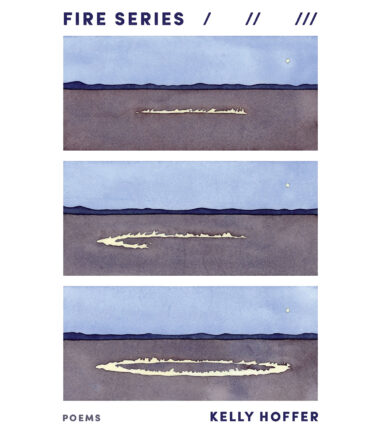
Kelly Hoffer’s Fire Series (University of Pittsburgh Press, 2026) asks what we risk when we put a name to our grief and how the description of what is gone might not only undo our relation to it, but might link us to the naming of the lost, instead. The mother’s loss, and her daughter’s, the speaker’s, only increasing distance from that event, troubles the static of the word “grief.” The formal reorientations via fire-as-series of lyric, musical interruptions of sound instantiate these poems as grief landscapes, as moving, becoming textural ululations of what it feels like to keep losing someone or something physically embodied on the page. I was so grateful to ask her about this beautiful new work via a Google Doc.
*
Alexa Luborsky (AL): I want to start with the middle of the collection, with “Brood parasite,” which I’ve loved ever since I first read it as a standalone piece in Poetry Northwest, and love more still in the context of the collection. The line: “my mother for example, my grief for another” reminded me of the opening lines of “Eve on fire // the hymn”: “for years I’d advocated for a horizontal transcendence / a body that wasn’t mine I was ready for.” I read grief as having the property of “horizontal transcendence” in these poems, or at least, a way I might describe the movement of it. First question, then, is poetry a way to let another body “take possession” of the grief?
Kelly Rose Hoffer (KRH): I love thinking about poetry as another body; this isn’t necessarily new—we are often asked to think about readers when writing, but I’ll admit I don’t usually think of a reader. It does, though, feel right to think about the language of the poem as a sort of body that can hold my excesses—something like a witch’s familiar—a being linked to me, but not quite me—and I appreciate thinking of that as embodied rather than merely a metaphor for a non-material interiority. Grief is so often captured in objects—pieces of jewelry and clothing that a lost loved one wore—articles that are proximate to a body and somehow take its shine and hold onto it (like those glow-in-the dark stars from my childhood?). Why can’t a poem work the same way? As a place to store something that we can’t bear to hold onto, or that we aren’t allowed to. We can’t inhabit edge states (extreme grief, ecstasy, pain) for very long (if we could they wouldn’t be edge states), but a poem can make room for holding those extremities, and give us a place to visit them when we need to.
AL: “Brood parasite” opens: “if we agree we take / possession of the things / that bear us.” There is no corresponding “then” to any of the “ifs” in the poem, which to me resonates with the refusal to diminish one thing causally with another. In other words, I read the opening as an invitation to acknowledge that “brood,” which you define in the poem as both verb and noun, “to cherish in the mind” and also as “parasite,” is accumulative, is transcendent, or as you modify in “Eve on fire // the siren,” is ecstatic. This is what language allows: “I have forgotten / if I am bigger or smaller than my mother—.”
These “two-way” relationships, as you put them, depend on “possession,” which you define as a haunting in this poem as well as an emptying. That, and I think in a lot of these poems, to name is to displace a relationship in forcing a language to it. This might be why, for example, the fire intervention/erasure of Genesis 3:24 first occurs after the expulsion, once it has been named, given that the poem is titled: “The first flame named only after expulsion.”
So, I guess I want to ask, in the context of these poems in addition to outside of them, how do we name grief, without forsaking it? And, if grief is like fire, how to explain that it might also be desire, loneliness, knowledge, etc . . . that it also might not be so intimate, so private, but permeates, spreads, takes, empties? And, if you want, where does that work happen for you? I mean, is it on the page, is it in your (beautiful) multimodal work, in teaching, life, or, as I suspect, does each method allow for a particular valence of grief to take possession of each medium?
KRH: I am thinking about how grief becomes new as we age even if the lost one doesn’t change. This is the great tragedy of losing someone as a young person—the relationship becomes increasingly asymmetrical. You continue to have a relationship with the lost person but they don’t get to experience the new versions of you. I think often of how much I’d like to fill my mother in on the news in my life. That asymmetry might be one of the things that motivates the yoking of erasure and accumulation in the collection—or at least connects those modes in my experience. Would my mother recognize me if she met me today? I’m sure she would, but that recognition would come with its own sense of loss—loss of the daughter I was, the child I was, to make room for the adult I am now. Naming grief might risk forsaking it, but naming can also be an invocation. I write about my mother and so here she is, brightening the pain I thought I put to bed.
As far as where writing about grief happens, or where grief happens, I suppose that’s a harder question; where doesn’t it happen? I do love your observation that the metaphor of a fire makes grief external or public (a shared threat)—something that might be unexpected within the American puritan imaginary. Just before and after losing my mother, I was living in Spain, and I was so struck by how much more comfortable my Spanish colleagues and friends were confronting that loss—how I was invited to speak about my grief—that it was not a source of embarrassment—that I was not rushed to get over it or to moderate my reactions. No one at my job was surprised that I decided to go home to be with my mother in hospice for 6 weeks! An understanding that strikes me now as very anti-capitalist and very, very un-American.
AL: Let’s go back to the opening poem, “A field (not on fire).” The title assures us that there will, eventually, be a field that is on fire. That we are to anticipate something by the loss of what it does, or what it did: to be on fire. This field, “a field,” with its indeterminate pronoun, suggests that it might be any field, but one that negotiates or instantiates perhaps “the flaming thing.” Or in other words, this field that is not on fire, manifests the thing that is. Or at least, this is how I navigate the turn in this poem from the indeterminate to the determinate.
Within the first two poems there is a child without a mother, there is a field that isn’t on fire, and there is a that speaker didn’t offer her hands earlier, that didn’t get to possess (which you define as a haunting) the mark of what is gone because of a missed duration.
When we have a time to name, and perhaps even rename (this, for example, not being your first book about the death of your mother), what of the thing it leaves behind as a way of distance, of locating a way to reapproach it, of continuing perhaps to return to it? And, I wonder also if becoming a mother while continuing to find what it means to grieve a mother also made its way into these poems and how that absence shaped the experience of writing this collection? And that fire, which is a thing that interprets energy from a landscape into something else, both changing itself and what it culls, feels kinned to the reasons these poems are not only playing with form, but also how they find their way into formal series, or things that exist alongside each other and not one after the other. So, I’d love to hear about the duration of grief and your titular decision of “Fire Series.”
KRH: I think of a series as evidence of dissatisfaction/desire. Feeling the need to name and rename. Say something and then take it back. But because there are multiple entries in the series we get to retain this self-correction/erasure/hesitation.
Or.
A “series” is a controlled change rather than total devolution intro entropy. When titling the collection, I liked that “fire” felt fundamentally uncontrollable or had the stink of some danger on it that “series” potentially tries to tame (I hope a little unsuccessfully). It brought the element into a ritualistic space. Into the world of art. A spell.
Or.
I think I might be writing the same poem over and over again but responding to different instructions (this time with more anger, this time with the dictionary, this time as Eve, please).
Or.
The grief of losing my mother was a rehearsal for all the other changes (aka small griefs even when they are joys) in my life—childbirth included.
AL: In “Pluming,” you write: “how do I protect my mother from my lyric tendency / to add the ornament, be it poison or polish or pith.” This anxiety of the speaker, replacing the mother, who died:
surrounded
by the sound of her children holding their breaths
listening for her to leave the room
and the poet then wanting to fill that room with sound, with the lyric. To that end, I want to ask a variant of a question to you that the speaker is asked in “Pluming” by another poet: is language meant to flourish, to bloom? It reminds me of a prose fragment by Celan: “I knew that anything that happened was more an addition to the given more than an attribute more or less difficult to remove from the essence, that it changed the essence in its very being.” Is what happens in the wake of the disaster, of the Edenic fall, or the death of the mother, or the fire part of this “blooming”? To me, language is the place, the location where something can be asked to both be on fire and not yet on fire, but that still changes the way we perceive, or perhaps even, remember, the field.
So, I guess I want to ask, one, do you agree with that interpretation, and two, what does this kind of in-betweenness, or what Anne Carson calls the “negative O” ability of language be able to define not just what isn’t there, but what something is in the negation of what it is not, do to the fear of grief’s metamorphosis of the self or of the dead or of the relationship between the self, and the dead? I’d love to hear your thoughts on how to bring bodies close without risking them, I guess, in the wake of disaster. And why choose language, in all its troubling facets, to do something that is like blooming or flourishing? I mean this literally: only flowers can bloom or flourish. You chose to write a book of poems. What did you want from language that you couldn’t want of flowers?
KRH: I love this question! Negative theology is something I return to again and again—we can think about God only by using language to describe what they are not—both because God is not immediately available but also because God exceeds language—so negation is all we’ve got in order to approach the divine however inadequately. We can replace “God” here with many forms of excess or unknowns: love, death, etc. So maybe the question has already answered itself. Flowers cannot negate! It is difficult to manipulate a flower that isn’t present in your hand. But it is quite easy to write a poem about a flower that isn’t present. Poems allow you to interact with things that are not physically available. We can be resource poor and still have a complex imaginative experience.
But I’ll admit, I’m often trying to make my poems more like flowers—or more like objects we can experience with our bodies. Even if this means just emphasizing sound to remind you of your ears, or emphasizing a poem’s visuality to remind you of your eyes.
Closer to the genesis of that particular poem, I was thinking especially about flowers’ association with beauty, and my own goal of abandoning, at least sometimes, poetry’s aspiration to beauty. Let’s let the flowers decay! Is that how flowers negate?
AL: In “Or am I a room with a roof taken off, still holding / onto my idea of a ceiling,” the speaker texts themself:
“can you hear a fire”
not asking about the moment
then but about the potential
. . . . . . . . . . . . . . . . . . . . . . . .
but I am stuck on the sound of something
big enough to kill me
And in “Pluming”:
having thought the thought too often about
my last words to my mother
her last words to me—I worried them down, I fear
I have lost them
I fear my poems
about her death will replace her
/
Sound here feels like the thing that manifests itself as “real” or as “existing” and, in fact, poses existential threats to both the mother and the speaker. If sound, let’s say, is the actualization of language, is what makes it “present,” is what makes it “real” for someone else (in the Heideggerian/correlational-ist sense), then what is the image? You also write, though, in “Ars poetica (clouded)”:
without poems I am not
sure I would know
the cloud
when I saw it
. . . and later, the speaker desires to write the cloud “once again for the first time / without metaphor.” I am curious because, you are someone who has a practice of making via light, and allowing clouds to occlude or reveal language, in UNDERSHORE, for example. So how does the image actualize, for you, or make real for you? How does this method, of using chance or atmosphere, of ceding control, work in relation or in opposition to actualization via sound? And how does that perhaps change the stakes of the poem when it uses metaphor/invokes the imagined rather than the stated?
KRH: Ceding control is fundamental to my poetics perhaps especially because I am bad at it. I am too often trying to write a “good” poem and thinking that I can do that through the manipulation of craft elements; this, in my view, is fundamentally mistaken. This is not to say that skill or practice is irrelevant, but I am not drawn to my favorite poems because they are proficient. I am drawn to poems that negotiate mystery, guided by something like Lorca’s duende or Spicer’s Martians. My best poems emerge when I forget how to make a poem.
Sound in a poem is both what signifies and what seems to exceed signification—it is the sensuous face of language. And just as we can recognize the face of another, that recognition does not exhaust the face’s contours, warmth, etc. Sound makes space for misrecognition, slippage, confusion—reading a poem aloud brings a little chaos into a poem, and who doesn’t like at least a little chaos? At times my poems move sonically first and conceptually second, or they allow sound to guide conceptual linkage—this is one way of letting a poem tell me where it wants to go rather than me telling it. Rather than forcing a poem’s details to conform to my idea of the poem, I am forced to follow a sound’s associations: “fountain” might take me to “fontanelle,” “mountain,” or even “counting”; but it probably won’t take me to “youth” even if that feels like the conceptual “fit.”
AL: This is sort of a part two to the last question, but the erasures of Genesis 3:24 in all its translations, are not complete erasures, but merely, perhaps, the mark of the spots that have been burnt, reimagined in the fire, that the darkened letters are what remains un-ashed of the landscape that existed prior and still exists through its ghost. Where does that mechanism sit for you? What does it actualize that is other than sound or metaphor? And, in one of the “the faces of a diamond” poems, you write: “the less I realized, the more the thing.” Does realizing something make it any less present? Tension between wanting to realize something and wanting to stay inside it/keep it from being exposed to time at all?
KRH: In this collection, I was interested in exploring the parts of the self that do not think or do not realize—it’s perhaps telling that “to realize” means both to understand but also to bring into material being—“the less I realized, the more the thing” is a line I liked because its meaning is multiple/slippery. In one potential reading, the poem might say, ‘As I understood less, I became more of an object, rather than a subject’; or in an alternate reading, the poem might say, ‘When I destroyed something, (as I lessened something, “realizing” less), thingy-ness became more present.’ I don’t have a particular intention for how these options for reading the line should interact. And I am sure there are more readings beyond these! But it’s clear to me that the poem wants to work with the way absence and presence relate to one another without working this relation out. Even as the poem tries to articulate something about the push and pull between the material and the conceptual, creation and destruction, the articulation splits and unsettles.
Since finishing the poems in Fire Series, I got pregnant and had a baby (wild). Pregnancy challenged my previously held ideas about poetic interiority. I was forced to confront the possibility that something so concretely interior could also be absolutely opaque (rather than revelatory)—a growing fetus both an essence and an other. This insight is no surprise to any student of psychoanalysis, and yet I had never had it rendered so literally in my life before being pregnant with my daughter. I’ve been trying to write about that experience by using techniques that challenge, but do not completely abandon, legibility (a mode that extends the work done in Fire Series’s erasures). One such attempt, called “Inside Voice” published earlier this year by The Rumpus, plays with a voice that is kept inside (unspoken), but also a voice made into a material—and captured inside the warps of a woven material. Here exposing language does not necessarily make it vulnerable to making sense, but there is still a sense of pattern. I’m not sure exactly where that work is headed, and that excites me.
AL: This collection ends with a poem on turning, which to me is tied with falling in this collection. “The first flame a vehicle,” ends with: “He drove / to keep.” In this way the story is not about what was lost/what fell, but in some ways it is also about knowledge, and the tree of knowledge being guarded. To which, we can ask, of course, to be guarded for or from? And I wonder about that as I write about the dead, or what I think to be “true” of the dead. Does my anxiety guard for or from? And who does it guard for and/or from?
As you write in “Eve on fire // the hymn”: “falling / was a kind of birth.” Also, “I open / my chest to the weather” is such a beautiful turn at the end of “vers” (please forgive my etymology pun, I cannot help myself). Weather is such an interesting concept. It is a unit of measure that, in terms of its origin, is meant to define what is “normal” for an environment, and emerged more broadly at the peak of colonialism wherein it was used to describe environments that were “other” than the metropolis.
I’d love to hear more about the complications of the body with respect to measurement. Where are we falling to? Or where are we falling from? How to measure the distance?
I want to pull one more thread into this. There are a lot of metamorphoses in these poems. Be they linguistic like in “Sex poem” where “light” is rewritten as “non-being” or where night (and in some cases day) is described as a bird. Or in the case of the speaker’s body, that they might be actualized as a doll, or in “Pygmalion iteration” as a collection of “ifs” that related to a beloved’s body as well. What does “turn” or “vers” or, even, fire, as ontology do in a poem or, if you’d like, do across this collection, for you? What do we get to keep when we fall? What do we guard by falling/claiming to know and wishing we did not? What does fire, as a series (sorry, title pun, once again, I cannot help myself) of beginnings, make possible that measurement, or, put in a different way, what we see after instead of during, cannot? Language is a kind of measurement, too. An afterword (pun, sorry) is a measurement. And lastly, does desire remove the frame of this contradiction (a riff of a line from “An exercise in which I try to see blue in the red flame”)? Take this in whatever direction feels good! I asked a million different things . . . but they all feel entangled to me!
KRH: Is fire a weather event? Not properly, but it affects the weather and is brought about by weather—and fire is the marker of the way that weather is less and less the “normal” and instead a series of exceptional interruptions (I’m thinking here of increasing forest fires with climate change).
My poet brain wants to connect “weather” and “whether.” I might just say that I think desire straddles contradictory states—I want something but I don’t have it. But wanting it gives it to me in its own way. Or desire travels across time (I want to inhabit the moment my mother is alive in the past even while I experience the moment in the present, when she is dead). Poems turn for similar reasons. They straddle the break between one line and the next, between this moment and the one after the breath. And sometimes we can only realize the full pleasure of this after having read a poem, or in rereading, when we get to encounter the line in anticipation of its coming complication/contradiction.