
Interview // “the falling of everything that must go”: A Conversation with Susan Briante
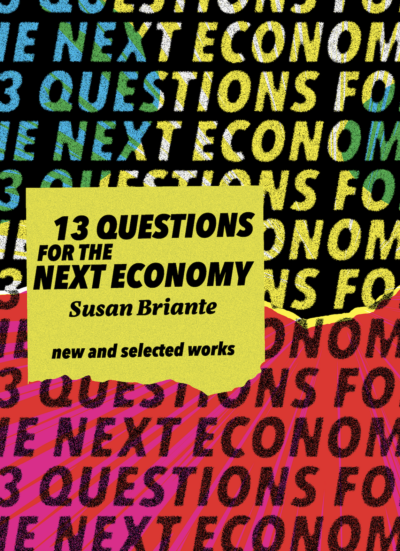
There are books that print their genre on the spine. Susan Briante’s 13 Questions for the Next Economy carries a Geiger counter instead. I skimmed it at first. A mistake. The book demands not a reader but a witness, one who is equally culpable. So, I started over, and read deliberately before reaching out to Susan. We discussed borders, on and off the page, the lyric “I” under racialized capitalism, and what poetry can say when economic language fails. Just like the book’s blank page marked “[Insert yours here]” at the end of one of the sections, hopefully our conversation leaves room for you to answer back.
—
Shriram Sivaramakrishnan (SS): Susan, of the myriad threads I could begin this conversation with, I am going with the one thing that struck me when I read your work, 13 Questions For The Next Economy, for the first time: the formal aspect of it, or a lack thereof. The book is a carefully curated set of new and selected works. The poems here, even the structure of the book itself, defy easy categorization. I am reminded of Zuihitsu, the Japanese-hybrid form practiced by, among others, Kimiko Hahn. One of the integral aspects of the form, Hahn believes, is the “sense of disorder” it invites.
This is not a question of form, but one of content, which is to say, intent. How did you decide what subject matter could go into making a poem? It seems to me there was little to no gatekeeping involved here, which comes as a breath of fresh air. From the ultra-private to the uber-political, nothing is out of bounds. In other words, what can take refuge or seek asylum in a Briante-poemland?
Susan Briante (SB): A border is a fickle thing. Here near Tucson an imaginary line divides the “United States” and “Mexico.” Designed to prevent the movement of people, it also thwarts the migration of jaguars and ocelots, black bears, pronghorns and mountain lions. But water and weather, capital and culture pass nearly unimpeded.
I’m suspicious of borders even on the page. I’m wary of the limits of tradition, expectation and genre. Who sets and maintains them? Who benefits from their enforcement?
For centuries, millennia really, the lyric has held whatever we ask it to, including every kind of sonic innovation or rhythmic deviation, all manner of new subject matter. It is a vase, as well as a microscope, a Geiger counter, a telescope, an archive. Most importantly it is a laboratory: demanding and encouraging different protocols and methodologies.
As an artist, one of my goals is to approach the process with a maximum concept of freedom, a boundless sense of possibility. When I think about the product, the output, the poem (for lack of a better word), I love to return to the definition of art posited by the Russian formalist Viktor Shklovsky, who believed its truest aim was to “defamiliarize,” to hurl the reader/viewer out of their habitual modes of perception in order to (literally) comprehend the world as new. This strikes me as an incredibly powerful and potentially political act. Why would I limit what I want (or want my readers) to (re)perceive?
SS: I love the idea of seeing the lyric as a Geiger counter. It makes of the poem an instrument of detection, something that would shriek an audible click under a favorable set of conditions. I cannot help but think of this set of conditions as the presence of a witness, the reader. I am calling the reader a witness because the act of reading makes them culpable, in the sense that they inherit, among other things, the vantage point of being a witness to the proceedings, one that seems to defamiliarize the subject as it does the form.
I want to talk about the piece, “What does a Postmodern poem look like? What does a post New York school poem look like? Where does lyric meet language?,” especially the way it ends with a set of questions:
What did you inherit?
What do you reproduce?
But it is not just these questions. You want us the readers to answer them in turn, one in the form of poetry and the other in the form of prose. This is a challenging ask for the reader, not least because the poems in this collection straddle the lyric and documentary poetics, but because in doing so, they subjugate the confessional I, by which I mean, the dictates of the form (be it collage, zuihitsu, or epistolary) often conflate the confessional I with the congressional I.
This is a roundabout way of asking, where do you situate the lyric self, be it that of the speaker or the reader, in these poems? And what are the implications?
SB: Let me start with a clarification: all the texts included in the collage “What does a Postmodern poem look like? What does a post New York school poem look like? Where does lyric meet language?” come from other poets who grappled with many of the questions I was and remain interested in while writing the poems that constitute this book. The questions “What did you inherit? What do you reproduce?” and the prompt that follows comes from Bhanu Kapil, a poet whose work and thinking I’ve long admired.
To return to your query, when I was first coming into my own as a poet the idea of the “lyric self” loomed large among the debates of United Statesian poets. What was a subject? What was author for that matter? If we wrote from the position of a stable “I” were we becoming slaves to late-capitalism’s obsession with an identity as a commodity? Could we only create a liberatory poetry if we shattered our ideas of the subject? And if we did, wouldn’t we also be abandoning a source of experiential and (potentially) political power? The writers I most admired at the time understood that any kind of either-or proposition would get us nowhere. They didn’t want to abandon the lyric I as a source of experiential knowledge or power—especially just as many women and writers from the global majority were sharing that experience and garnering a kind of literary power. But they did not believe in the fixity of the “I,” nor centrality. They were wary of its commodification. They experimented. I think of CD Wright’s proclamation:
I aim to carry the smoked ham of my voice to Beulahland. I do not intend to write as if I had not gotten wind of “this here” or “that there” semiotic theory . . .
I think too of Alice Notley who wrote “the pronoun ‘I’ is a word that should be given back to people, who need it, but deepened.” And I believe that everything that Notley has written constitutes an enormous example of the various, beautiful ways that “I” can be expanded, penetrated by other voices, experiences.
Which brings me back to Kapil’s questions “What did you inherit? What do you reproduce?” Once you realize you cannot, and perhaps don’t want, to escape the “I” or your lyric positionality, the questions “What did you inherit? What do you reproduce?” can become keystones for an ethics on the page (and off).
SS: There are many threads to parse here. I am quite intrigued by the idea of a “lyric positionality,” as opposed to the widely-proleptic “lyric personality.” I suppose the difference is, if there is indeed one, spreading, in Steinian terms, a kind of “an arrangement in a system to pointing.” A denotative position that deftly undercuts questions of a poetic subject. I mean, what is even a poetic subject?
I can’t think of a better way to segue our conversation to the section, The Market Wonders. In one of my favorite poems from this section, the speaker says that “[m]other is not a biological or relational subject position but can be an attitude of resistance before the market.“
At first, I overlooked the connection. Then I re-read the first piece in this section— I am referring to Toward A Poetics of Dow— where the speaker asserts that the “Dow touches everything: the taste of our water, color of our sky, torque of our engines,” before raising an interesting and important question, “Now corporations have the same rights as people. Why can’t poems?”
Is the stock market, then, measured by the Dow index, a worthy candidate for the poetic subject, one that is capable of carrying the lyric I? And if yes, just like the corporations, can the lyric I be held accountable if not culpable? The bigger point I am trying to touch upon is, can the questions Kapil raised still remain keystones for an ethics on the page (and off) for the lyric I in a capitalist set up?
SB: That really is THE question. Which is another way of saying that is THE challenge of the moment. Is there even an “I in a capitalist set up,” or are we nothing more than the sum of credit scores, buying habits and worth on an ever increasingly unfair labor market.
I am interested in the lyric as a place in which one can explore their positionality, their privilege and complicity in relation to racialized capitalism. I am still very moved by something that Juliana Spahr wrote in 2002 in which she theorized the lyric as a “space of intimacy [that] has the potential to be an exemplary space for examining political intimacies, race and gender intimacies, and community intimacies in addition to its relentless attention to more personal intimacy.” It’s also a space for disrupting notions of the “I” itself, for questioning the idea of subjectivity as fixed while not denying the power of speaking out of lived experiences even and—especially as—our intellectual and aesthetic relationship to those experiences will never be fixed.
And I do believe there can be a power of tapping certain traditions, Kapil’s and Notley’s being just two of many which contest an imposition of a subject bound to aesthetic or capitalistic expectations. “What did you inherit?” and “What do you reproduce?” strike me as having a potential both on and off the page to create a starting point for the kinds of inquiry that are necessary at this moment, especially when we situate the self, the you in Kapil’s query, in relation to any number of others.
SS: What of the body then? Not just the body. The presence. In Specimen Box, the speaker says,
In our luminous day to day,
the poem was
a record of presence, attention. Music
rises from the deep lobes of lung.
In here, music is seen not as an aesthetic but as a physical and embodied enactment. I am pole vaulting to Other Denver Economies, where the speaker admonishes,
Most of the time
we think of the body as fixed
in value—
The implication seems to be that the body is not a fixed entity, just like—I daresay—the Dow Jones index. I was laughing when I read The Market as Composition. The poem lists, if that is even the right verb, the Dow Jones indices on the days of the deaths of different poets. So if there is a correlation between the body and the market, it is not readily apparent. My intention is not to alienate the body from the self, and make of it an automaton. Quite the opposite. What I am interested in is the ethics of bringing another being into the racialized capitalist set-up. I keep going back to Toward The Shoreline, especially to these lines,
I want to teach my daughter how to swim, how to live off the grid, how to grow her own food and make her own art
but what I need to teach her how is how to die
or how to live as if she is already dead.
What kind of intimacies are being enacted here? And, more importantly, how does lyric as a space comport with the politics of the body?
SB: The omnipresence of the Dow Jones indices throughout The Market Wonders marked an attempt to represent the interpenetration and insistence of market forces over every aspect of our lives. During the financial crisis of 2008, one in an endless series of crises and when I began working on that book, I became especially aware of the ways in which the “health” of the stock market indices became the main indicator of the health of the economy, regardless of jobs numbers, home ownership or other possible indicators. Personifying the market was meant to draw attention to something that was already happening: in common parlance and economic reporting the market is described as an actor that reacts, gets jitters, rallies and falls. Even that word “health” is a personification. And the way in which corporations or the government (as our alleged representatives) respond to the market correspond as if it were an omnipotent and (often) irrational god. That said: I think it’s vital to remember that the stock market is NOT a person although the policies and actions taken in the name of or in relation to “market forces” have actual often life or death consequences on real people.). That’s the correlation between the body and the market that feels most apparent to me—and most devastating. It’s not that the market has become a person, but that persons become subsumed into a market “logic” into the valuations of the market. And (at times) it is so overtly apparent the ways in which human life becomes sacrificed to the valuation of a corporation in the market. Still, the market is not some angry god. We can take action to affect market outcomes (through boycotts and calls for divestment).
To answer your question: how does the lyric as a space comport with the politics of the body? I believe there’s a tradition that assumed a particular body, perspective and ideology and assumed it to be a “universal” lyric representation. But that (in actuality) the lyric as a container can hold the representation of a variety of embodied experiences as well as experience that might transcend or seek to dissolve the notion of unified embodied experience or subjectivity. To me that’s the beauty of the lyric.
SS: Your articulation of how market logic subsumes personhood is deeply compelling, especially the distinction you draw between the market as a metaphorical “actor” and the real bodies affected by its valuations. I’m curious, though, about how poetry itself resists that subsumption. Formally or lyrically, what can the poem do that economic language cannot? How does the lyric recover, complicate, or rehumanize embodied experience once it has been absorbed into market logic? That is what I was hoping to mean by “comport.”
SB: Ahh . . . okay. Well, I think there’s all kinds of ways in which the lyric can be absorbed into a “market logic” unfortunately. But one thing the poem can do, which the market cannot/will not do in its current construction, is to be self-reflective. Poetry can not only reflect on its own existence within a literary tradition,[1] but it can reflect upon, test and collaborate with the material of language itself. Here I think of a skilled craftsperson: a woodworker not just using the wood to build, but seeing what is possible with the piece of wood they have chosen. Or Michelangelo releasing the figure from the stone. A poem works with words. A poet can push and transform the language. The poet and poem can reveal latent or new meanings in language. In capitalism, language functions merely as another tool used for the accumulation of profit.
SS: And how! The self-reflective capacity of Poetry with a P is nowhere more apparent than in the penultimate section, Defacing The Monument, where we find the speaker sitting at the back of a courtroom, scribbling on a legal pad. The speaker acknowledges the complicity of language structures, starting with something as crude as a line:
If a line is dot that went for a walk, then a wall is a line that
divides
Nogales, Arizona, from Nogales, Sonora.
Then, the speaker points to figurative devices that give the language the power to make, mask, and masquerade:
Metaphors make circles of our lives: a Venn diagram of contrast and resemblance.
But it is at the level of semantics that we locate the danger of Poetry with a P becoming complicit with, if not culpable to, powers that be:
Every summer for the past three I have gone to Nogales, Mexico, with students from the University of Arizona’s Southwest Field Studies in Writing Program to witness and write about migration (...) as we bear witness to conditions migrants face, we wonder: How can we amplify voices without turning other people’s stories into commodities, without re-affirming the faulty myth of “giving voice”?
This poem is followed by a series of writing prompts, before the reader is led into a blank page, well, almost:
WHAT DOES A TWENTY-FIRST CENTURY LYRIC LOOK LIKE?
[Insert yours here]
It is a call for poets and readers alike. Given all this, I can’t help but ask you this: How do we affect a lyric that takes part without partaking in the proceedings? I do understand the pitfall of framing a call-to-action spectacle as a question that begs a prescriptive answer. I am happy to run with however you decide to interpret it.
SB: Any strategy must come out of the realization that the poem can become a commodity. How can we allow it to be a relational instead of a transactional space? For me, that comes from considering the poem as part of the historical moment in which it is created, as well as taking into account the diverse readership that will hopefully receive it and the various (and differing) means by which the poem might come to them (as part of a book or an anthology as a photocopy as a something heard or overhead spoken by me or someone else), etc. I don’t mean to suggest that all of that is present (or should be) at the moment (or many moments) of its creation. But at some point, I acknowledge the poem as part of a larger conversation. That can be both liberating and intimidating. If I remember the interactive and relational potential of the poem: a more honest and a more curious version of a speaker tends to appear on the page.
When we understand the poem as part of a web of moments, relations, histories, and potentials, it can begin to transcend its status as a product. It becomes part of a process that one (as a writer) is only a part of. The poem continues to be in process long after it leaves the writing desk. I find that liberating for a poet and ultimately for poetry itself.
SS: And may this book continue to be a part of our shared collective discourse long after this interview ends, speaking of which, I can’t think of a better way to end our conversation. But, if there is one thing I gleaned from 13 Questions, it is that no form of questioning and answering session will be complete without a “Postscript.” I am, of course, referring to the last poem in your book.
I want to memorize this piece so that I can drop its lines, air-quote them like they are mine every time I feel overwhelmed. Like this one:
How do we “root” without becoming a gun in the glove box (...) How do we photosynthesize? Be a circle of soft green arrows on a classroom poster?
I am tempted to leave our readers with this one, though, the last line in the collection:
May we assemble like a sonnet, get projective in the streets, revise a history of soot into our seedling.
But I would settle for my own postscript: as of this writing, 13 Questions for the Next Economy has made it to the shortlist of the 2026 Firecracker Award in Poetry. Fingers crossed, Susan.
As for the final word, I will leave that to you.
SB: I think my final word must be a reminder that no one of us can really have the final word at this moment of so much crisis and potential. I am so grateful for your attention to my work, your questions, and the opportunities for reflection they provoked. And I hope my book and our conversation leads people to other books and writers (some of whom we’ve discussed above) and other ways of thinking about and acting within the current moment. I often return to the words of Diane di Prima, who wrote in Revolutionary Letters,
NO ONE WAY WORKS It will take all of us
shoving it this thing from all sides
to bring it down.
Thank you, Shriram. Here’s to the falling of everything that must go and the possibilities in what we can build after.
[1] Read the poet James Agee’s “Preamble” to Let Us Now Praise Famous Men for a lesson in the potential for self-reflection in literature: “It seems to me curious, not to say obscene and thoroughly terrifying, that it could occur to an association of human beings drawn together through need and chance and for profit into a company, an organ of journalism, to pry intimately into lives…”