Interview// “The World Begs for Transcription”: A Conversation with Asa Drake
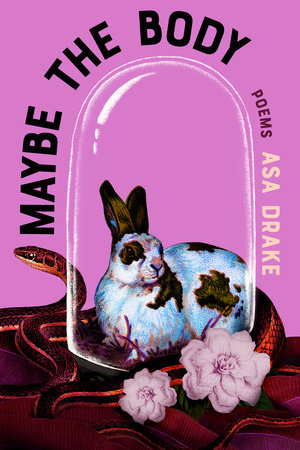
Asa Drake’s full-length debut, Maybe the Body (Tin House, 2026), is a tender collection exploring relationships between families, lovers, citizens, and strangers. With an inventive precision, Drake investigates legacy by searching for her aunt’s translation of “Tagalog Whitman,” intimacy through a series of bittersweet sonnets, and cross-cultural identity via the limitations of language.
*
C. E. Janecek (CEJ): I’m a big fan of your pet rabbit, Bun, who makes an unofficial appearance on the cover of your newest book. Could you speak a little to the relationship between humans and animals in Maybe the Body? Many different animals appear in your text and the speaker seems to yearn for an animal attunement to the world—seeking not just understanding—but bodily instinct.
Asa Drake (AD): When I was in grad school, I was given the craft advice to keep a plant or a pet. I laughed it off, but having my first adult pet has been an experience. There’s a different degree of trust and reliance that I’m trying to gauge with my rabbit as a prey animal. Frequently that means admitting that we excuse a great deal of violence in the name of the status quo. If I know, for example, that an aggressive guest will stress her out (and cause intestinal disorders due to that stress), what are ways that I’ll vocalize boundaries to someone who expects access? And at this point, the question is no longer about domestic rabbits but about domicile and safety and of course, the body.
I’m obsessed with the gap between semblance and representation of a thing versus the thing itself. What’s lost in between signifier and signified as Saussure and the linguists might say. I think the allure of animal attunement (what a lovely phrase) is that we might somehow avoid the failures of language which so often feel, to me, like a personal failure to understand and be understood. I admit, it’s self-indulgent to use the natural world in this way. I think it’s constantly necessary to confess and interrogate the metaphors that arise in these images. They’re human shortcuts. But if it’s a shortcut I’m making, where is it that I want to arrive? Often, I choose to interrupt the natural world with an inclusion of some aspect of the human body, be it hair or birth control or personal mythology encapsulated within the image. Is there something I can better understand because I am a little clumsy in these moments?
CEJ: Actually, I think you’re incredibly precise in this collection—particularly when you write about language and its imprecision—alluding to what’s left unsaid or lost in translation. The very ending of the collection stands out to me, from “Toyo”:
I wanted to warn her about tinik but I didn’t want to say tinik and I didn’t want to translate bone into smaller bone. I had already translated this dish into miso soup when it’s really a variation of sinigang. Everything about me is an affect of failed language. The metaphor is a sign I’m lonely. So you can hear me better.
There are also many other moments when the speaker tells us, “I can’t say” or “I never asked” or “Now I fear being told I / speak nothing.” What are some of the ideas you want to convey through this duplicity of language? Is there something you think best remains unspoken?
AD: In customer service one avoids negation because it often points to a conflict. For example I might say “walk please” instead of “no running” and replace a rule with a directive. I’m really interested in why the command is less offensive than the rule—or is it that we choose not to leave the rule open to interpretation—crawling, jumping, sitting, all of these might be alternatives to running.
I bring up customer service because my twenties were filled with rote language that was heavily corrected to ensure a welcoming environment. I still worry about whether what I say will make me less approachable, which is such a cornerstone for customer service, and breaking an internalized rule, subverting positive language reminds me I can say it all. The undefined negative feels especially delicious to me. The negative creates uncertainty like a question.
When I’m writing, I often think about what should and should not be said. I believe in the importance and validity of secrets, especially in a state that does not value human life. There are so many reasons why I want to be specific when I write—as an act of witness, as an act of gratitude—but I also want to acknowledge who has to bear the consequences for the image or history I might convey. The final edits and poems for Maybe the Body were written during the first three months of the second Trump administration. Legislation and memorandums about birthright citizenship, “reimmigration,” transportation across state borders (in terms of healthcare, in terms of immigration status); these all made me keenly aware that I couldn’t write a record—I couldn’t document a history—that would be universally acknowledged.
CEJ: Speaking of history and documentation: at the beginning of each section you use the framing device of “Tagalog Whitman,” as in, a narrative about searching for this Whitman text that was translated by your aunt, but ultimately being unable to read it because of restrictions on certain manuscripts crossing various borders. Can you tell me more about this form and frame?
AD: Whitman is just thought of as such a looming figure in American poetry, but for me, my interest stems from my aunt’s poetry and learning more about the poets she admired. The braided essay in Maybe the Body in which I seek out Tagalog Whitman started as a long, lineated poem, but I wanted both the room and the density that prose allows. I’m really grateful to Aja St. Germaine at Honey Literary for helping me expand and take advantage of all the factual details that orbited this piece: elections in the United States and in the Philippines, my work at the library, changing interlibrary loan policies in Florida, familial houses, inheritance.
I did all of these things to try and gain access to what is essentially some aspect of a family archive, and it never manifests. That absence, and the forces around it, become essential to how I ordered the collection as a whole. Including the reasons why I hesitated to request Tita Nena’s translations a second time. Like, what is the scope of ILL for a public library? Am I doing academic research purely because I’m requesting a text from an academic library? Alongside these questions, I became interested in how institutions offer access. How do we try to create efficiencies in the name of access, and what ends up not happening because of those efficiencies? Tagalog Whitman, for me, is that moment where access is lost to efficiency.
CEJ: I have one more question about Tagalog Whitman’s form; you reach toward and draw from many different writers in the book, along with this germination point between your aunt and Whitman, where you use a lot of footnotes. Those notes reminded me of Jenny Boully’s The Body: An Essay or Vasvi Kejriwal’s current manuscript I recently had the pleasure of workshopping. How are these notes adding to your meta conversations?
AD: The footnotes are remnants of when the essay was a poem with a lineated form! There’s one footnote that reflects on Mark Twain’s proposed flag for the Philippines; in the very first draft it had the shape of a flag with little like asterisms for the star field. I pulled back from that because it was awful, but there were many failed attempts at seeking that I wanted to preserve. In the text, each footnote is labeled an “attempt.” I enjoy the mess of it, how the seeking spills over. One thing I like to do in the space of a poem is to practice what I don’t feel comfortable with. This braided sequence is very much born out of that impulse. I think that looseness and mess made me feel like there was room for me to enter into Tita Nena’s work and Whitman’s work, despite how grand I find that ambition.
CEJ: Interesting! I’ve been deep in revisions of some very old poems that felt almost hopeless before I brought them to Tin House; some were pre-2020 during my undergrad years, others from early in my MFA. I recently revised a poem into the zuihitsu form for the first time. It was originally a very linear prose poem I wrote in 2022 and breaking it apart felt so productive—both across the page and across time.
AD: I don’t think I’ve ever written a true zuihitsu, but I love the form. I love the possibilities that happen in a long breath. And this can come from the unbroken line, or from the stanza break around the singlet. (I love the term singlet!) There is the possibility that, in this moment, you can go on for as long as possible, the possibility that the line continues beyond the page, beyond any limitation that you might constrain line length. In the best scenarios, I feel like I’ve reached something strange and surprising at the end of such a line.
I draft so many poems in singlets or monostiches. I find the juxtaposition that comes out of these accumulated lines so fruitful. More intentional lineation comes later—right now I have an A6 journal, so it does create a certain line break that I start to read into, and that it takes a lot of effort to make clear to myself that I’m not limited to that. Sometimes I write across the page, but when I know that I need the visual effect of the longer line, I’ll swap for an A4 journal (which takes forever to fill up).
CEJ: My own drafting journal is really narrow, but when it’s time to transcribe the first draft of a poem, I’ll type it into my computer with no line breaks at all.
One thing I was taught to while revising my poems during my MFA was that a writer almost has to earn a wider margin over the course of their career. Since many journals have fixed margins and presses have to account wider trim sizes into their printing budget, it can be—quite literally—an investment in a debut poet to accept a non-traditionally formatted manuscript. The shape of the poem can become deeply tied to the business and power of publishing, not just the art.
AD: I’ve started to think a lot about the practical advice I was given regarding publishing as a student and how I often advise students in a different direction. The idea that one has to earn something in poetry—what is there to earn? What are the stakes of publication vs. what are the stakes of writing the poem? I think the stakes of writing often feel higher, so I give students permission to indulge in long poems. So often, especially with students drafting their first poems, the urge seems to be to take up as little space as possible. To write a feeling as concisely as possible. I’m more interested in what comes next. I want to give permission for the longer poem to see where you’ll end because I often find, I’m most interested in what comes after the clean ending or oracular statement. I try my best to encourage students to go ahead and write beyond what’s comfortable or what might sound intelligent. And I think longer lines push toward that, even if it may not be the most editorially sound advice. More poem gives you more poem! If we’re pressed to that next stanza, that next addendum, what discomfort or what excitement do we find for ourselves?
CEJ: Speaking of the process of writing itself, I want to ask you about the poem “The World Begs for Transcription.” As a poet, I laughed and commiserated with this stanza:
On a podcast, a poet I love names the many accountability
groups she’s joined this year. I am jealous of her
self-discipline and the word accountability, used as a term of
self-discipline, but that is not what I want.
The following line reads like an ars poetica: “I insist on protection. Pick up an omen the last night of the year. Foremost sin in my mind, the one not worth confessing.” Tell me about your own writing practice—what role do accountability and protection take for you as a writer?
AD: I often like to practice using words I don’t fully understand in poems. Like trying to use a word in a sentence as a learning exercise. Accountability is a word I struggle with—at times it suggests punishment. Other times it implies the act of confession. Or even efforts toward clarity and transparency (of action or intent). I’ve always been an anxious conversationalist, and the poem is so similar to a conversation. I think poems give me room to practice being braver than I am—in conversation but also when confronting or claiming a tradition, a home, or something else.
When I want to push forward, I try to think of three documents or objects (books, films, music, art or something else) that a poem might be in conversation with. What was it, exactly, that moved me? What are key terms (either from these works or their descriptions) that stay in the back of my head. If archival knowledge that is meaningful to me is in someone else’s possession, what offering would be appropriate to the holder or curator? Zora Neale Hurston once brought Cudjo Lewis a gift of peaches before transcribing his oral history. I frequently consider, when writing poems that involve other people, what I’m bringing to the table. Is what I bring worth the exchange?
CEJ: You have so many beautiful poems about gifting and exchanging. I always notice how there is a great tenderness in your work. I loved returning to all of the different sonnets titled “To Someone Who’s Heard, I Love You, Too Many Times.” With each poem, I was rethinking what the title meant. How did you come upon this series of poems and what was your process when writing and curating them?
AD: These were a very late project for the book—I had included maybe three in the draft I’d sent to Tin House. I was actually reading your incredible “The Smallest Possible Shape,” Rhoni Blankenhorn’s “Rounds” and Jimin Seo’s “Ossia” that fall, so I was surrounded by these really incredible crowns of sonnets and wanted to attempt my own, but they didn’t quite come together that way.
I consider the break between poems a chance to turn away, and with this sequence, I very much felt pulled to the exit. The structure is another choice I make to avoid suffering. When we take a breath, we make room for ourselves, we take up more space and allow the possibility of something different to happen.
I complained a lot about failure, and that made the sequence easier to write—either because I received so much help and encouragement or because I came to terms with altering the parameters of what I might accomplish. Jimin Seo suggested to me an invented and alternate form, a monostich crown, which I use in my second collection Beauty Talk. Each section is composed of (ideally) seven monostitches. Each monostich is divided into two parts with the last line of each section repeating as the first line of the next. I kept going between these monostitches (how I often draft my notes which turn into poems) and the sonnet sequence in Maybe the Body. It felt like breath-work. Eventually I culled some of the sonnets (you’ll see spots where the attempt toward repeating lines is dropped entirely). Others became fractured with partial omissions. As much as I admire form, I didn’t want to force a shape. I hope the connective thread between poems—attenuated as it may be—still offers continuity to the reader as it does for me.
CEJ: Shifting just a little, this collection grapples with the (in)visible—whether it’s the invisible labor of women, the (in)visibility of Asian women in America, and what it means to be seen as white or Asian (as well as both and neither) by others. A quote that stuck with me from “Letter to My Younger Self”:
Today, I was told
most mixed-raced women die in fiction, which implies
that the living version of myself is difficult
for others to imagine.
How do you approach writing about identities which inevitably some readers will be coming to from a place of ignorance or inexperience? Does writing these poems ever feel like a re-wounding?
AD: With as much weight as we give authorial intent, I think it’s equally important that we understand our own nature as readers. Do we come to a text purely for pleasure, to feel some aspect of ourselves heard? When we express confusion as readers, how much of that confusion is an unwillingness to be offended, to be in conflict?
We live in a world where we avoid conflict often at the cost of clarity. What a gift that poems are interactive because as a reader I can choose to meet a poem. And as a writer, I can also create a selective membrane—I can choose to keep someone on the opposite side of a door and I can even say, in this poem, I will not meet you halfway. I’ve wasted so much time assuming my own strangeness and how I might put others at ease. Whatever ecotone I live in—it is not the uncanny valley. It is a real and human place. I was able to write Maybe the Body because I took for granted that I could write, not towards explication, but towards inquiry. I took for granted that I am not here to explain myself. And I think this is a premise that means I won’t satisfy all readers. I’ve struggled with that reality, but I reject the standard that my role as a writer is to grant universal access to my experience, to my body, to the explicit source I’m citing.
There are so many books that have helped me better define a poetic practice separate from my desire to please others. Janine Joseph and Kiki Petrosino are two poets I reach for when considering what shapes amplify a narrative that may, necessarily, explore a personal archive that feels omissive. I’m also really grateful for my notes from a conference a few years ago where I had the opportunity to listen to Donika Kelly speak about poems in The Renunciations. Kelly described using bracketed caesuras as a way to save space for a later epiphany. And that on revision, Kelly would then determine which of these caesuras would stay. The brackets became a way to hold an epiphany or a violence that she did not want to replicate within the poem. I frequently rely on Kelly’s description of caesuras in my own work. I think working with omission—incorporating the absence rather than attempting to fill it—is one of the ways a poem can account for and acknowledge an emotional or historical fact that might otherwise be distorted through a retelling.
CEJ: I love your answer—especially the way you describe the “selective membrane” of how much the poem is willing to explain, or rather, how it should be explained before it becomes distorted by forcing legibility.
AD: I worry it’s all logic trying to make myself seem less bitter.
CEJ: Not at all—or maybe the perfect taste of bitterness. In my own workshop experiences I’ve often found that readers really differ on how much they expect a manuscript to explain itself to them; and it’s not always surprising who expects that legibility. It’s often been women of color who’ve encouraged me to explain my queerness less, while sometimes the only comment I get from (usually) a white, cishet man will be, “Are you sure you’re not alienating your reader if they don’t know all this stuff?” Meanwhile, the root of the poem is simply desire and sensuality—something that feels universal unless the reader is unwilling to see past the difference. I think as readers, we’d be missing out on so much if we didn’t try to engage with work that wasn’t written “for” us.
AD: This brings to mind a James Tate quote that I really love on silence:
Poetry speaks against an essential backdrop of silence. It is
almost reluctant to speak at all, knowing that it can never fully
name what is at the heart of its intention. There is a prayerful,
haunted silence between words, between phrases, between
images, ideas and lines. This is one reason why good poems can
be read over and over. The reader, perhaps without knowing it,
instinctively desires to peer between the cracks into the other
world where the unspoken rests in darkness.
I think a lot about what silences we allow ourselves. Maybe it is easier for people to take this from James Tate, because he is someone who reflects the image of the canon. But this is the quote I think of when I’m considering what degree of legibility I owe the reader. I’m always a little worried honestly about who I give access to. I do think that there is some truth to the Tate quote, that there is a reader who desires an almost voyeuristic peering between the cracks, and sometimes I am glad to offer that glimpse, but I’m much more interested in offering a mirror than I am in offering a window (in the way that in librarianship, we talk about for some readers, a book can be a window into another culture, and other way of living, or it can offer a reader a mirror of their own experiences and the assurance that they are not alone).
CEJ: I’ve always loved the windows and mirrors metaphor. It’s part of librarianship, but I’ve always seen it as an important aspect of writing.
AD: A lot of Maybe the Body was written at the reference desk. And I’d say most of it is written from 2016 into 2022, a time period which coincides with me working at my local library and learning best practices within the field. As I’m learning this terminology of how we think about readers, how we think about readership, how we think of creating access through literature—all of this became a lens through which I wrote about how I found myself perceived.
I think working in libraries made me a lot less worried as a writer about a general audience. As a librarian, it would be ridiculous to say, “This is the one book I recommend.” Librarians always conduct a reference interview. We say: “Tell me more about what you’re looking for at this moment. What are the shows you’re watching? What are the last books you read?” Because we’re always continuing a conversation with other art and when we’re helping readers, we’re always looking to see, well, what’s something that’s in conversation with what this reader has read that will allow them to continue exploring an interest. And as a result, I never really worry about who my book will appeal to. I’m more interested in what work my book is in conversation with. When readers might reach my work as part of this conversation, and who will I point them to next?
CEJ: What do you want to leave the reader with at the end of Maybe the Body?
AD: “Toyo” is the last poem in the collection—it’s a big prose block which ends with a reflection on Emily Dickinson’s “I measure every Grief I meet (561).” So much of the writing of Maybe the Body is an act of seeking a mirror for the self. It’s a difficult thing for me. A reflection has endless appeal and abhorrence to me. I wanted to end with something comforting—a meal—to encourage myself and others to return to the collection as a whole.