
Interview// “To Bear Witness to One’s Own Life”: A Conversation Between Hyejung Kook & Mia Ayumi Malhotra
Mia Ayumi Malhotra’s latest book Mothersalt (Alice James Books, 2025) explores the tenderness and strangeness of childbirth, pregnancy, and early motherhood as well as what it means to be “that impossible beast, that mother who also writes.” As Mia and I are both busy mothers and poets with little extra bandwidth, I proposed an interview format of asking one question in a shared document and Mia responding before I asked the next, approximating the rhythm of an in-person interview but drawn out over months rather than minutes. The first question was posed May 7, 2025. Partway through, Mia started asking questions about my debut poetry collection, Once Is Not Enough (CavanKerry Press, forthcoming Fall 2027), a book haunted not only by loss—death and miscarriage most prominently—but also by the tender details of the world, peonies reemerging in spring, the taste of salt licked from your palm, the music of overlapping voices and languages.

Hyejung Kook (HK): I love how your book begins, with its dedication “for my daughters” and the first poem, “Where Poems Come From.” The speaker addresses a young child, probably her daughter, about seeing a duck for the first time and naming it, but then declaring:
This isn’t really about the duck,
the pointing. The point is that I saw you seeing
a creature for the first time—paused motionless
on the bridge, bits of debris shifting underfoot.
Every day you make some new utterance—ball,
more, meow—closing the space between the world
you live in and your name for it.
I found myself thinking not just about where poems come from but where people come from and how language is essential to both. Could you talk about how poetic and personal lineages figure in Mothersalt?
Mia Ayumi Malhotra (MAM): What a lovely question to open with, Hyejung. Thank you! To me, this entire project is an attempt to trace my aesthetic lineage as an artist-mother—a matrilineal throughline—if you will. In my late twenties, I had a very specific sense of who I was as a poet; the constellated voices of Elizabeth Bishop and Jorie Graham, along with Quan Barry and M. NourbeSe Philip, were how I knew myself, my voice, my aesthetic sensibility. But childbirth changed everything. In Ayşegül Savaş’s The Wilderness, an exploration of the first forty days of new motherhood, she tells the story of an anthropologist who was attacked by a bear, which bit off part of her jaw and two of her teeth:
From then on, she would be part human and part bear. This is what I recall from the book . . . that it describes perfectly what has happened to me: I have encountered another being, and have been torn apart. I am trying to put myself together, not sure how the pieces will fit back in.
Like Savaş, in the wake of childbirth I had the feeling that I had been torn apart and didn’t know how to piece myself together again, not only as a person, but as a poet. Somehow, the writer I had been lacked the formal means to enact on the page the exhaustion, interruptions, and ongoing-ness of what I was experiencing in life. And so I found myself reaching beyond the known into an open, undefinable space, which mirrored the formlessness I felt in this major life transition. It wasn’t until years later that I learned this process has a name, matrescence, and that artist-mothers were publishing books like The Wilderness and Jazmina Barrera’s Linea Nigra: An Essay on Pregnancy and Earthquakes in their efforts to navigate this bewildering, unmappable territory. I suspect that if I had encountered works like these earlier, the process of writing Mothersalt would not have been so lonely—or circuitous. Over time, however, a new self did emerge, buoyed by the voices of writers like Adrienne Rich, Rachel Zucker, Rivka Galchen, Cherríe Moraga, Maggie Nelson, Carmen Giménez, and others, who have written about mothering with both unrelenting ferocity and tenderness. Through their work—most of it very different from the poetry I wrote in my twenties—I began to enter a new way of inhabiting language, one that felt as fragmentary and elliptical as my experience of mothering did. What’s more, I discovered that this form I was finding my way into not only had a name, fragmentary prose, but an incredibly rich history, originating in the wandering, miscellany writings of Shōnagon, Bashō, and Yoshida Kenkō, whose cultural and aesthetic legacies I could claim as my own.
[MAM: As an aside, it feels so appropriate that our exchange is taking shape this way: incrementally, painstakingly. The form of this interview, unfolding over an extended period of time, with its many gaps, interruptions, and silences, is in itself a reflection of the poetics of mothering, evidence of the way our attention is constantly drawn elsewhere; how, as artist-mothers, writing takes place in the interstitial moments between care for children and household.]
[HK: July 12, 2025. 12:48 AM. I am lying down next to my son who had woken from a nightmare but has fallen back into sleep. I am waiting for him to be deeply asleep enough for me to be able to get up without rousing him, and in this moment of forced stillness, I find an interstice to read MAM’s response and continue our conversation.]
HK: I find myself wanting to know more about your sense of fragmentary prose and a “poetics of mothering.” There’s an interesting tension between implied grammatical breakdown in fragmentary and a syntactical coherence in prose. How does fragment work in relation to your ideation of prose and your sense of rhythm within individual poems as well as across the book? For instance, the choice to have multiple poems titled “Mothersalt” and “Dear Body—” feels like a kind of rhythmic choice on a macro scale.
[MAM: August 19, 2025. 9:13 AM. Standing at the kitchen counter, I open my laptop and return to this interview after more than a month away. With kids at different schools, it is both the last week of summer and first day of school, a strange, transitional space in which I feel increasingly lost. In the weeks since Hyejung’s last question (family travel, summer outings, playdates, piano lessons), I have managed to jot down a few scattered notes but have not had a chance to collect my thoughts in any meaningful way.]
MAM: I love how you characterize that tension: grammatical breakdown, syntactical coherence. To me, it feels related to the poetics of collage—something whole made from something (or somethings) cut or torn, perhaps with jagged edges; material that feels alienated from a larger schema or story but, joined to a whole, acquires its meaning through relation. I’m thinking here of the many art forms that are comprised of discrete yet recurring gestures/motifs, repeated across the fabric of time: embroidery, mosaic, quilting. Also, potentially: mothering. Can you tell that Ruth Asawa’s sculptures and mothering practice are central to my conception of art-making? I’ve learned so much from her sense of the line—sculptural, in her case, but related to my understanding of the poetic line, not to mention matrilineage and intergenerational caregiving—how it carries on, continuous form within a form. This may be related to why Mothersalt is structured as a series of poetic sequences (“Mothersalt,” “Dear Body—,” the “On___________” poems), interwoven or “looped” across the book in one, unbroken progression. Even the poems that appear as standalone pieces can be read as a kind of narrative: Bad Birth: A Retrospective. Deliver. After/birth. Sheltering. Spring. Last Day in Laguna. Today. Late Spring. And voilà: the story of the book, both in parts and as a continuous whole.
Right now, I’m trying to think about why I have such strong feelings about the relationship between fragmentation and coherence. Maybe this is my version of the way Fanny Howe talks about bewilderment in the opening chapter of The Wedding Dress: Meditations on Word and Life, as a poetics and as an ethics. Maybe for me, the poetics of fragmentary prose is fundamental, not only to Mothersalt as a book, but also to my understanding of myself as an artist-mother. So many stories exist in the world about what it means to make poetry, or even just art in general. Who makes it; what it’s made of. I want to say that the poetics of mothering, with its lapses and grammatical breakdowns, allows for a truer definition of coherence, one built from apparent incoherence, at least on a surface level. This may be related to intersectionality—how it feels to inhabit multiple “opposing” identities in one body, which requires a more expansive narrative about who we are, and, even more importantly, how we are. An integrated self that doesn’t see these identities as conflicting or contradictory (poet, parent, woman, teacher, artist, Asian American), but as a different form of coherence, one that exists through relational means.
I want to ask about your debut collection Once Is Not Enough (and huge congratulations, by the way—I’ve been waiting to read this book of yours for years!!), coming out in Fall 2027 with the fantastic CavanKerry Press. How have you described this book over the years, either to yourself or to others? What separate selves/identities are voiced by its constituent parts, and what, if any, is the story that holds them together?
[HK: It’s 11:26 PM, September 5th, my kids are asleep, and I should be sleeping, too, but I want to at least start to answer this question, and it feels necessary to start with a bit of ethos, to speak to how I’ve come to be in this moment and this conversation. I make no claim to be an impartial reviewer here—we are poets in community who first “met” via a postcard poem exchange in April 2013. And the first—only?— time we’ve crossed paths in real life was in passing at AWP Tampa in 2018, shortly before Mia’s debut Isako Isako (Alice James Books) came out. But I love that out of these brief moments of connection, our language and paths are crossing now in this deeper way.]
HK: Thank you, Mia, so much for your thoughtful questions and enthusiasm for my debut collection! My first book-length manuscript was my undergraduate thesis, called Black Lute, completed in 2001, which was followed by a chapbook-length for my MFA at NYU called Chromatic Intervals in 2005. But when I tried to combine the strongest work to make a book, I was dissatisfied. The poems didn’t feel good enough and the manuscript didn’t feel coherent enough, thematically or stylistically, although when asked what my writing was about, I’d say grief, family, and music, which are throughlines that continue into Once Is Not Enough. It wasn’t until 2023 I finally stopped dithering and put together a manuscript I started to submit. Someone told me to think of a book as a signpost. I’m sticking poems together into a collection—here is where I am poetically at this time—but it’s just one moment of gathering in a continuing practice of writing.
The collection contains poems written between 2000 and 2023, so there are quite a few selves in this book, including the daughter, the granddaughter, the musician, the Korean American, the not-fluent translator. The poet who mourns, the poet who praises. The trying-but-failing-to-be-a-mother. The mother. I briefly considered “pre / / post” as a book title, with the unstated thing between the / / being my first miscarriage, but I rejected this title because it too strongly suggested straightforward linear progression. Once Is Not Enough fits better by conveying a sense of repetition and the recursive, cyclical nature of life and grief. There is affinity with Mothersalt in the looping sense of things as well as “a truer definition of coherence, one built from apparent incoherence, at least on a surface level.”
[HK: September 15, 2025. 9:00 PMish. I’m ignoring the sounds of my kids fighting instead of sleeping to pose another question.]
Mia, I’m wondering if you could speak more about “meaning through relation,” and “coherence…that exists through relational means” in your poems. Lately I’ve been thinking a lot about poetry as well as life in terms of speaker and address and relation. Who is speaking in a poem? On what ground—intellectual, metaphorical, physical or something else—does the speaker stand? Who or what are they speaking to? How does the speaker relate to the addressed? And of course there can be multiple valences within a single poem, and increasing complexity as poems speak to each other and to the reader’s mind and unique internal connotations.
[MAM: September 16, 2025. 11:39 AM. Standing (again!) at the kitchen counter, I read Hyejung’s response after dropping the kids off at school and then draft a few emails. Meanwhile, the plumber arrives to fix our shower, and as I move to the dining table and (between periodic check-ins with the plumber) begin jotting down notes, I marvel at how different life—and the quality of my attention—feels in mid-September, as opposed to August.]
[MAM: October 8, 2025. 12:52 PM. I return to my notes from September and begin typing up this response in the precious hour between walking with a friend and picking up my kids from school. Looking at the calendar, I realize that the weeks ahead are full of school in-service days, parent-teacher conferences, and actual holidays. I won’t have a regular work week until November.]
MAM: It’s interesting to think about speaker, audience, and address in Mothersalt. The majority of the poems address a period of time when my body’s awareness of its immediate surroundings was on high alert—and yet, at the same time—it felt like an incomprehensible blur. Maybe it was sleep deprivation or the roller coaster of postpartum hormones, but I have trouble recalling those days, and I’m grateful that the book documents things like the shape of the newborn’s fingernails; the bleached, mid-December light; the clanking of the radiator. Those are the details and textures that my memories have lost over time, so much so that a part of me wonders: did I know, writing these poems, that that would happen? Was I perhaps writing for a future “me,” one who would no longer remember how it felt to be a first-time mother? And because Mothersalt was written between the births of my two children, how much of that first birth did I actually remember, and what parts of the story did I invent or reconstitute from a hazy, half-remembered past? These are the kinds of questions that run through the book, thematically speaking: nostalgia, the elegiac quality of memory, the heartbreakingly specific poignance of caring for the very young, who change so quickly that their lives sometimes “appear to be no more than a shedding of selves through the years.” Moments lost, even as they’re remembered.
Perhaps that’s why so many of the poems in Mothersalt are addressed to my children—the entire book, even, as you pointed out in your opening question. From “Today”: “Today you saw a giraffe for the first time and said, Gi’affe! Gi’affe!” and from “Where the Poem Comes From”:
Every day you make some new utterance—ball,
more, meow—closing the space between the world
you live in and your name for it.
Maybe this is the ambition of the book: the desire to address my kids’ future selves, people who might want to know about these things one day, things they have no hope of remembering unless I tell them.
Someday, you’ll want to know where you come
from, and I’ll point to this memory:
you, at two, running along the side of the house—
sand-streaked, shivering, hosed clean
at day’s end. What we leave behind: a line of white
stones, picked from a bed of rocks.
At the same time, it’s strange to think that the “I” of the poems is a lost subject: a speaker who no longer exists except in the book, one who speaks from a lapsed world, even as she refers to birth as “a faraway country” and mourns the loss of that “merged self we make: mother, mouth, milk” after weaning her baby. There’s so much grief in the poems, which I wonder about. Whether it’s tied to epigenetics. Across two adjacent poems in the “Dear Body—” series, you write: “The tang of melancholy, seeping through amniotic fluid” and in the next, how inside each story there is “another story, just as inside every mother is a daughter—and a daughter inside her.”
Throughout Mothersalt, the “you” of the poems is almost always my children—except when it isn’t. In the “Dear Body—” poems, for instance, the speaker turns to address her own body in an attempt to understand the bewilderment of her childbirth experience. Trying, as she says, “To put our bodies back in the story, and the story back into our lives.” In a strange way, it feels healing to be both speaker and addressee. To be called upon to bear witness to one’s own life. Maybe this brings me back to the poetics of collage, a form of making that is predicated on the ragged, uneven stitches that seam part to whole.
As you can tell, I’ve also been thinking a lot about different forms of relation, and what it means to exist in language (and in life) in such a way that these relationships bring coherence to the otherwise disjointed reality of human experience. Again, thinking on the level of the sentence or line, I wonder: is the fragmentary prose lyric where lived experience can find a form of coherence through the wandering, meandering poem? Its slow unfolding of lines, accumulating on the page?
I’ve gone on long enough, but maybe another way to think about this is in the context of music, where individual notes don’t mean much unless they’re brought into relation through the syntax of the melodic or harmonic line. Sometimes people talk about music as, not the notes, but the space between the notes, as in: the intervals, the crackling current that charges the air between the decay of one note and the attack of the next. It’s all about the pattern, the connection, the web, if you will, of disparate elements, all drawn into relation through the musical universe of the composition.
I love the way you talk about time and experience as recursive, and how your book’s title, Once Is Not Enough, illuminates that concept so elegantly. It makes me think about musical forms like the sonata or fugue, in which a theme is introduced, and then reconfigured through a series of variations, which eventually return to the original subject. This actually brings me to my next question, which has to do with your virtuosic “Invention” poems, a form I haven’t encountered elsewhere, and with which I immediately fell in love. The intricate counterpoint of those voices, entwined on the page like that—I find it so visually arresting, and, of course, the language itself is stunning. How did you discover the form of those inventions, and what informed your composition process? And relatedly, once the poems were written, how did you make decisions about their titles, sequence, and where they would appear in the book?
[HK: November 2, 2025. 10:13 PM. This past October I decided to try to write a poem a day with a cohort of poets, the first time I’ve attempted something like this since October 2015. I did in fact draft a poem a day, but my typical output is 4-8 poems a year, so I feel like I ran four marathons in a row. Both exhausted and exhilarated. There is a tangible cost to this: I dropped many more parenting balls this past month. For instance, I missed my daughter’s parent-teacher conference because I mixed up the day in my calendar, and brought her to early morning math club a week too early. But here I am, now, drafting a response.]
HK: I love thinking about the “I” of the poems as a lost subject and what it means to exist in language and the connection you draw to music, how “individual notes don’t mean much unless they’re brought into relation through the syntax of the melodic or harmonic line.” The form is directly inspired by J.S. Bach, particularly his 15 Two-Part Inventions (BWV 772-786). I was (and still am) a serious amateur pianist, and my love of Bach comes from my teacher Mrs. Beatrice Allen, who studied at Julliard with James Friskin, a Bach specialist. Baroque music is contrapuntal, where each part has a distinct melodic line rather than a single melody over a harmony. Bach wrote in up to five parts (or voices) for keyboard, but I decided to keep it simple with just two. Mrs. Allen had us students analyze the structure, identifying the subject, which always begins in one hand, and the countersubject, which joins in partway through on the other hand. Both subject and countersubject reappear with different variations as the piece proceeds, and the piece always finishes with a return to the root or tonic chord. The invention in C major, for example, finishes in the C root chord.
So the invention poems are written in couplets, with each line of the couplet to be read like music for two voices, with the readers’ voices overlapping where the two lines overlap. Since the duration of spoken language does not correspond with the visual length of lines, the visual and aural focus is what happens at the places where the lines begin each overlap. I tried to hold onto a sense of a musical subject, a countersubject, variation/progression and resolution in the poems. I was interested in suggesting a multiplicity of possible language paths and slippage, or to paraphrase and expand your earlier comment, to expand the different kinds of relation by syntax. “Invention No. 1 in a minor” is the first I wrote, and in one couplet, the first line, “rent open with each contraction” partially overlaps with the second line, “The body, an ocean, produces.” While reading, the eye slides down and sees the possibility of “rent open with the body, an ocean, produces.” I also wanted to explore the way words tend to dissolve into sound with the sonic interference of overlapping voices. When meaning breaks down, we still experience language as sound, as music.
My ultimate intention is to write a full suite of invention poems, either fifteen, emulating the Two-Part Inventions, or twenty four, one in each possible key, but I haven’t completed the project yet. Honestly, it has created a bit of a conundrum for me with titling and numbering because I tried to choose keys that felt like a tonal match to the poem, but then I tried to exactly match to the keys of the Bach inventions, so started messing with the numbering, which traditionally corresponds to the actual order in which the pieces are written. I’ve decided to let things simply be, for now, and I decided to space them out in the book, so the “Invention” poems recur like a musical motif.
MAM: I also wanted to ask about the title that you chose not to use for your book, “pre / / post.” In the caesura, or gap, or breakdown between words (before, after), we encounter a gesture that both contains but also fails to hold “the thing”—a miscarriage, as you say, but also so much more. As you ask in “할머니 / Halmoni”: “Why is so much left unsaid?” and “What stone is in my mouth?” How does Once Is Not Enough reckon with the unutterable: the afterlife, the ghost, the unspeakable presence? Can you talk about the ways you’ve sought to represent that which exists, unspoken, in your writing/life? And what is it about the way you inhabit poetry—or language, more generally—that makes this possible?
[HK: November 18th, a little bit of interstice between appointments and kid pickups. I have been writing poems not daily but with every day intention, and today, I wanted to essay answering in Haibun-fashion, with prose and poetry.]
HK: I’m thinking again about what you said previously about music “as the space in-between notes.” The rejected title held both prenatal and postpartum for me, but I also wanted it to hold more broadly about a before and an after—what exactly? Whatever the reader brings to the table. I cannot recall which poet Phyllis Levin was referencing, but she spoke of the poem as a table with chairs and settings, and how one chair and setting should be left unoccupied—that is the space for the reader to sit down at the poem. We need a place we can enter the language.
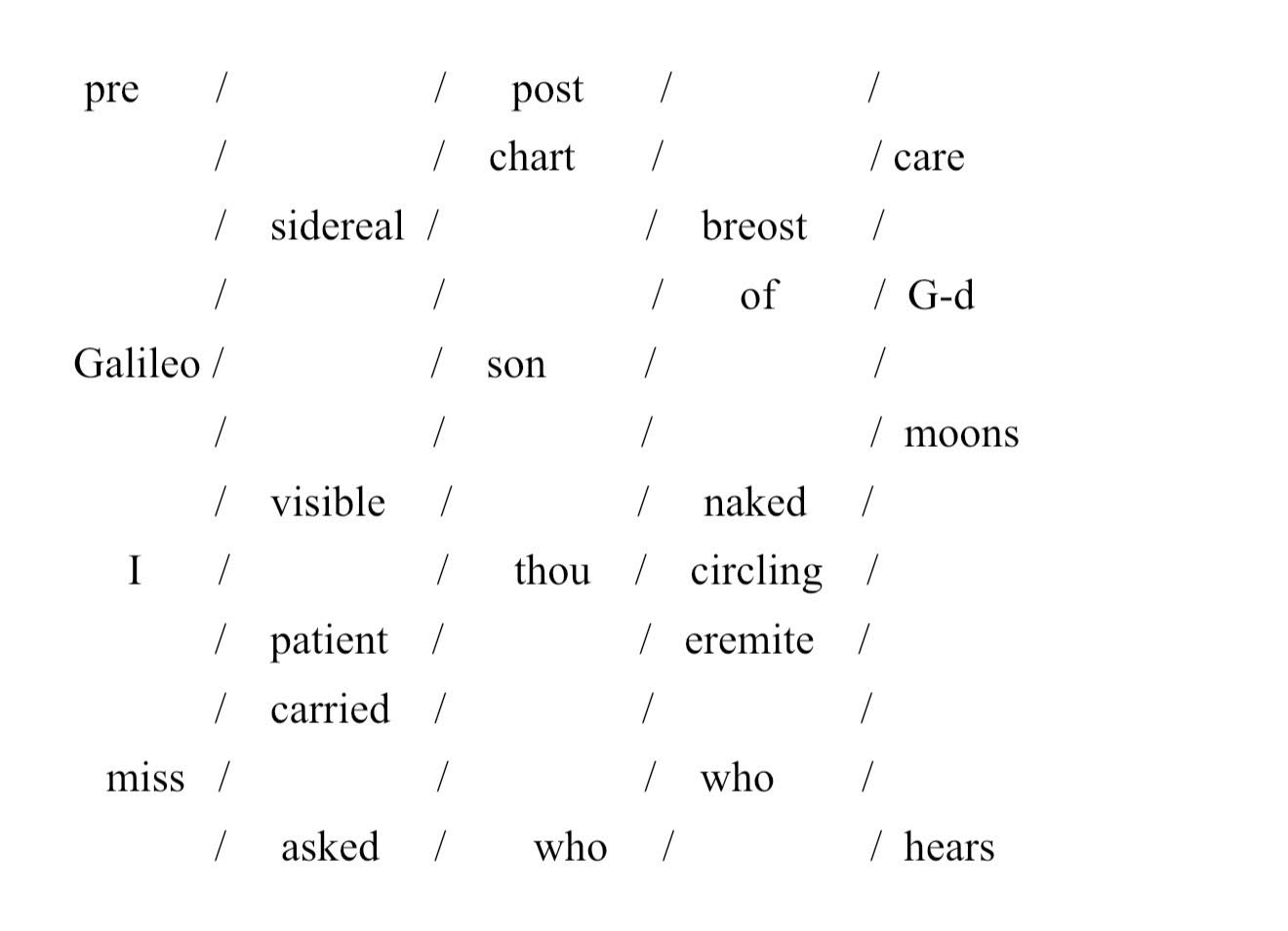
My writing has been deeply marked by how much is unutterable in language, and the ineluctable gap between language and the actual experience, feeling, and thought that my words try to convey. While this quick draft of a poem riffing off of “pre / / post” can be seen as a very opaque and strange, I’m trying to render the reality of living as fragmented, elliptical, associative, not fully articulated. Our thoughts and lives do not follow orderly narratives and clear subject-verb-object syntax. The rooms of our minds do not fit into the precise confines of stanzas and lines. There is so much unsaid, so much lack, and here I signal it with with empty space and slashes. At the same time, I hope the space being marked on the page, like measures in music, invites the reader to bring their own connotative echoes to the language at hand, their own inner song of the spheres.
[HK: December 3, 2025. Another pause with fall break and the Omaha Zoo and seeing migrating birds at Loess Bluffs and my mother-in-law’s birthday. The richness of Mia’s questions require ample time to mull over and respond.]
HK: I feel like I’m not quite answering some of your wonderful questions. But I think that’s actually part of an answer to how I inhabit language and approach what is ineffable. I know that I can’t capture. I can only approach, approximate, and gesture toward. In “Halmoni” (which means grandmother in Korean) and other poems, I’m speaking to my beloved dead, to family who didn’t speak English and I could only talk to with the most rudimentary Korean. My family moved to the United States when I was baby. My parents spoke to me only in Korean at first but switched to English when I started school, and I lost most of the fluency I had. But when my haraboji, my maternal grandfather, passed away during my sophomore year in college, I was filled with regret as well as grief. I had never been able to have a proper conversation with him. I took Korean language coursework my junior and senior years and went on Fulbright to South Korea after graduation. I got into my first poetry workshop with Forrest Gander as a junior as well.
Losing my haraboji shaped me fundamentally as a writer. At my core, I’m an elegiac poet. I perceive everything as touched by loss. But that doesn’t mean I walk around suffused with sadness all the time. Knowing the transience of life also fuels in me deep joy and gratitude for being present, as well as a desire to be as open to the the world as I can manage. Losing my Korean has led me to work to reclaim it, to try to have conversations I never had in the past. I can’t have them in real life, but I can have a version of them in poetry. And while living with different languages underscores how much of experience is untranslatable, it also has expanded my feeling for language’s possibilities.
I want to connect back to Mothersalt and mention your next collection you are working on with the organ. And how dgacasssscsccsadxxZSASAS1dsf f s1111a1adq2euyriu687t86t768t76767676767676767414141414141414141414676767676776767676766
676767676767676767677
777776767766767676767676776767676767767676767766776767ujho/;ogktg;oih5
[HK: hijacked by my nine-year-old daughter]
[MAM: January 9, 2026. 11:46 AM. I reopen our doc and begin to read Hyejung’s responses at the dining table, then move to the couch with a blanket. At this time of year, there’s a mild Northern California chill in the air, and the season feels on the cusp of new horizons, beginnings. Growth, change.]
MAM: Retracing the arc(s) of this amazing, monthslong conversation, I’m struck by the immensity of this gift. For our voices to have found each other—somehow, through life’s immensity!—and to have explored and echoed one another in the shared commons of this exchange. . . . I realize now how very accompanied I’ve felt by your thinking and living throughout these many months of caregiving, art-making, parenting, writing. Thank you, Hyejung, for the uncommon gift of your voice on the page; your music in the work; your mind in the world. I’m deeply grateful.
[HK: January 12, 2026. 8:30 AM. I’m solo-parenting again and didn’t get much sleep last night, but the kids are in school, and I’m sitting in a Panera with a cup of coffee and Ellie Goulding’s “Lights” playing in the background. I’m nibbling on mochi pancakes from yesterday morning that were out on the counter all day but are still delicious.]
HK: In my incomplete response last December, I found myself going into a poetics deep dive from the richness of your questions, but resolved to come up for air and bring myself back to Mothersalt. Mia, I, too, feel immensely lucky to have been living alongside your writing and thinking in this way and discovering unexpected overlaps in our interests both inside and outside of writing.
I think one of the things I admire most about Mothersalt is how it engages with and expands my sense of language’s possibilities, how it draws me into relation with the speaker but also offers new nuances to my own relationship to mothering and writing. In “On Form,” the speaker traces the way her writing changed after becoming a mother—less shapely, more wandering: “And so I began to build strange, unkempt houses for my words to live in. Interior spaces without doors, only half-imagined windows, which opened to rooms where a person could wander, lost, for days.” And, in one of the “Dear Body—” poems (which Mia mentioned earlier in relation to the possibility of epigenetic grief): “What if inside this story is another story, just as inside every mother is a daughter—and a daughter inside her, and still another, nested forms reaching through time.”
The sense of transforming space and form and how we make meaning with language feels like a kind of linguistic afterbirth. To be pregnant, to give birth—these are experiences that are inescapably embodied me—by which I mean I was confronted continually by the fact I had a body, one that was doing amazing, terrifying, mysterious work beyond my control. The act of literally continuing a lineage for one more generation also requires an act of splitting, division, and postpartum—after parting is a false etymology but feels emotionally true. Earlier you said you felt “you had been torn apart and didn’t know how to piece myself together again, not only as a person, but as a poet,” but you have certainly pieced together resonant language with a compelling sense of fragment and structure in this collection.
Mia, thank you for this nourishing and inspiring exchange for these past months and your patience as I have worked to bring together the threads—dare I say the lines—of our conversation. I’m very much looking forward to your next project, The Organ Sonnets, in which you explore music, the interior life, and the architecture of memory. I hope we can have another conversation when that book emerges into the world.