
Public Poems: On Reading The Selected Poems of Essex Hemphill
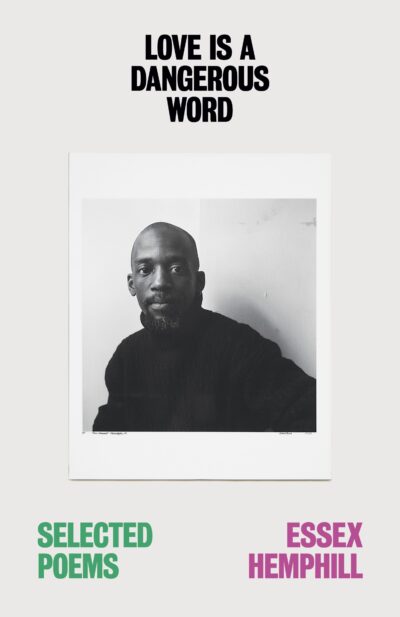
Love is A Dangerous Word: Selected Poems
Essex Hemphill
New Directions, 2025
“We really represent the beginning of it all, the beginning of no masks, from Stonewall forward, and each decade we’re throwing away more masks.”
[Essex Hemphill in conversation w/ Randy Boyd]
Essex Hemphill does not allow complacency or apathy in himself or his reader. He was proud to “buy” himself the time to write the poem “American Wedding” with his 1986 NEA government grant money. “In America/ I place my ring/ on your cock/ where it belongs.” Here is desire, this exuberance of life right along with death, constant and close and early for him. For friends and collaborators too—Marlon Riggs and Joseph Beam for whom he wrote “When My Brother Fell”:
When my brother fell/ I picked up his weapons/ and never questioned/ whether I could carry/ the weight and grief,/ the responsibility he shouldered./ I never questioned/ whether I could aim/ or be as precise as he./ He had fallen,/ and the passing ceremonies/ marking his death/ did not stop the war.
No rose colored glasses. This is war, you know your side. The work never ends and is not always victorious, seamlessly he accepts this. There is no other way. His poems and essays beat down a path through the hateful world. Each line defies the hetero white supremacist view. He chooses to be public, to show his life, despair and joy, clearly. He takes the reader to the bedroom, the bathroom, to cruise along the curb through pick ups, hook ups, love and loss. All necessary set up for lines like:
I look up at the stars at night / and think they are too small / to bear the weight of what I wish for you. (Chances are Few)
While the poems appear straightforward in their physical construction—along the left margin, each establishes a stanza length for itself—they are not simple poems. Metaphor is only thinly veiled, does not hide meaning. Soft repetition, or the line changing slightly throughout the poem. With only a few words per line, my desire to read on is subconscious. What carries me through? Hot breath, stark narrative that never really ends, instead, hovers around the poem. Thought becomes statement, image establishes the poems’ roots.
Even hope is a device // I will never come back. / I’m sent below earth / to violate its intestines. (Forever)
***
Hemphill bends a live wire through an intimate tone. These are the sorts of poems I would only expect to hear from a friend or lover, to be rolled across our tongues, around our lips, to fill crowded rooms. There is a general ache and a want for a love that is as constant as it is evasive.
I long for the occult sciences/ to inform you of my affections,/ and if this evidence, is insufficient,/ then let a single dream/ containing the content of my soul/ spill throughout your sleep,/ and from all the nights/ I have longed for you (So Many Dreams)
The fabric of these poems is soft from infinite use: ode, critique, proclamation, and story, full of lush images that Hemphill vibrates to never quite settle, each poem comes to a stop with a restless pulse. A conclusion jagged and still in personal need. The poems stay close to his body and stay in the city. Each establishes its own thread, then is knotted, broken, re-tied, tied to something else. Nothing is static. Movement, in thought and body, from beginning to end. The smallest things given their weight. A kiss as common as a killing. “Cordon Negro” starts:
I drink champagne early in the morning/ instead of leaving my house/ with an M16 and nowhere to go.
and ends:
I leave my shelter,/ I guard my life with no apologies./ My concerns are small/ personal.
The house becomes a shelter and neither are home. No place to go, then, he leaves. What gets him out? The deep thought of the daily act. He leaves us on this flippant line, aware of how big his concerns actually are, as he thrives through threatened territory and its fragile locations.
I’m young enough, black enough / To be shot on sight, questioned later. / I’m a son. My life is a hunter’s season. / Dark men, men of color / Must always be alert. / Surprise is life costing. / Surrender is treason. (Surrender is Treason)
“My love life can kill me” he writes in “Cordon Negro”. The stakes are high. His poems heighten the danger on him. In “Ceremonies”, Hemphill writes about bringing his chapbook to his Grandma in South Carolina, “I promised my family I would not reveal my sexuality to Grandmother, I took a copy of Earth Life to give to her. On an early afternoon…while Grandmother sat rocking on the front porch…I pulled out the copy of Earth Life knowing the moment to give it to her had come. I realized that she would learn more from it than I would ever be able to tell her in this life.”
He goes to the barber and returns to find his grandmother in silence, Earth Life open beside her. “These are very good poems, Essex, but they’re a bit disturbing’…. She then looked me directly in the eye and smiled just a little slyly before asking, ‘Essex, do the authorities know what you’re writing about?’ I guess they know what I’m writing about, Grandmother, but I can’t really be concerned with the authorities.’Some of this is very disturbing,’ she said, “and I just want you to be careful. I don’t want you getting hurt out here.”
***
If I had a brick / and fast legs./ if I had a gun / if I had an army (Forever)
He created Be-Bop books and published his five chapbooks, all out of print now, with beautiful covers by artist friends: “Diamonds Was in the Kitty” and “Some of the People We Love” (1982), “Plums” (1983), “Earth Life” (1985), “Conditions” (1986). He started “Nethula Journal of Contemporary Literature” (1979) and edited “Brother to Brother” (1991). “Ceremonies” (1992) his collection of prose and poetry needs to be reprinted.
***
Sometimes I hold / My warm seed / Up to my mouth / Very close / To my parched lips / And whisper / I’m sorry (Rights and Permission)
Sadness (his own sadness or someone else’s?), then “parched lips” quicken thirst, then more tension, another need of the body obstructed in the poem. How do you write about your love and sex? What poems do you write when your T Cells drop? When all of your body’s defenses are failing?
In 1994 Hemphill shared his poem“Vital Signs”, “Erection my downfall/ as opposed to my rise” and after spoke saying “One of the identities I presently wage, battle with, accept, reject, is being a person with AIDS.” Robert F. Reid-Pharr writes in the introduction that Hemphill went on to say: “If I had known sooner the true power of love to heal and affirm, I would have left the bathhouse, bushes, and book stores immediately…I would have pursued a healthy way of living with more diligence than I gave to pursuing and busting a nut.” Again an apology to the seed. “He sat in front of an adoring audience, eyes damp, lips dry, and watched them watch him die.” (xi)
He was a public person and poet, life and work grafted at the cell. He demanded it to be this way. Coming out at a Harvard reading, sharing being HIV positive to a crowd. Hemphill wrote for the people around him as much for himself.
I live in a town / where pretense and bone structure / prevail as credentials / of status and beauty— / a town bewitched / by mirrors, horoscopes, / and corruption…I live in a town / where everyone is afraid of the dark. / I stand ground unarmed / facing a mounting disrespect, / a diminishing patience, / a need for defense. (Family Jewels, For Washington D.C.)
Before reading this poem at the Mayor Arts Awards, The D.C Commission of the arts demanded he remove “corruption” from his performance. He agreed, then read the complete poem, speaking a momentary coup in that violent space. His grandmother had every reason to worry.
The need for a defense is constant. His position from defenseless to deft strategist shifts routinely throughout the poems. He pivots the energy set against him to his own uses. Ready for the split second, peace or violence, all ways facing (forward).
He offers no escape (days off) for the poet, does not entertain frivolous thoughts in his lines, runs midnight raids. Everything is built as a weapon of expression that does not allow fancy or magic without purpose. These poems are continuations of his daily liberation. Now, the poems stand out––a home built in the 80s on a block with 50s architecture and he is too easily locked in a conversation of identity rather than poetry.
The last poem of this book is “Considerations”,
It starts,
Be careful with your life/ even when risk seems minimal./ Be careful with your trust/ even when love is being claimed./ Be careful to speak exactly what you mean,/ lucidness is the first step to becoming./ Honor your every loyalty, / the first being to yourself.
and ends,
We started out as fuck buddies/ Now, occasionaly, we make love.